Briefings

Allotments need to be planned

July 17, 2019

Allotments seem to suffer from a problem of perception. Even in today’s policy climate in which food growing is increasingly prominent, and with the prospect of new legislation being brought forward to confirm Scotland as a Good Food Nation, the evidence suggests that most local authority planners still regard food growing simply as a leisure activity and as such fail to prioritise food growing when considering land use in local plans. While highlighting some notable exceptions in Aberdeenshire and East Lothian, SAGS have just published a nicely illustrated guide for the rest of the country’s planners.


Author: By SAGS

The Scottish Allotments and Garden Society are pleased to announce the publication of a  ‘Plan to Grow – A Planning Guide for Allotments’, author Steven Tolson, Consulting.  The intention of this guide, funded by Awards for All Scotland part of the National Lottery, with help from Planning Aid Scotland is to help inform Scottish Local Planning Authorities about the importance of food growing in our local communities.  Further copies of this report along with a more detailed report are available as downloads from our website


The Society and its members are aware that proposals within the current Planning Bill are for local communities to have a greater role in the planning process including the development of ‘Local Place Plans’.  As an organisation we are very supportive of the planning commitment to a ‘plan led’ approach and creating better and healthier Scottish places.  Clearly, we believe to achieve better places there needs to be a commitment to providing more land for growing local food.


Such a commitment is wholly in line with the Scottish Government’s aspirations to become a ‘Good Food Nation’ by 2025.  The Scottish Food Industry is a very important part of the Scottish economy and local non-commercial food growing production should be recognised for its growing contribution.  The ‘Plan to Grow’ guide makes some important points about the wider health and well-being benefits of food growing for individuals and crucially argues that growing one’s own food makes a significant contribution to social interaction and cohesive communities.  As you know such attributes are all part of a spatial planner’s tool kit.


With the enactment of the Community Empowerment (Scotland) Act 2015 legislation now being exercised by communities across Scotland, the provisions of the Act will have an increasing influence on the way local development plans are prepared and agreed.  Specifically, the provisions of Part 9 of the Empowerment legislation along with the supporting guidance highlights the roles and responsibilities of local authorities in the provision of land for food growing and its future management.  To this end, as key land management professionals, the Guide argues that Planners will inevitably have an important role to play in identifying and facilitating more land for food growing as part of the wider objective of making better places for Scotland.


The Scottish Allotments and Gardens Society hope that the Guide will assist you and your planning colleagues in developing policies for local food growing that achieve a wide beneficial impact for Scottish community well-being.
Briefings

Lotto lunacy

It’s 25 years since Mystic Meg first enticed the nation to part with its hard earned cash in the hope of winning the National Lottery jackpot (current chance of winning Lotto - 45,057,474 to 1). The early assurances that Lottery funds would only ever be used to add value to mainstream public funding - and never to replace it - has long since been forgotten. There are so many lottery schemes on the go today that it’s hard to keep up with. Now plans are being laid to launch a local authority lottery scheme. Is there no end to it?


Author: By Improvement Service

A community lottery for Scottish local government

For a number of months, the Improvement Service has been facilitating discussions with councils on the potential to establish a local authority lottery scheme.

This is possible within current council powers and has been successfully pioneered by a growing number of local authorities in England.

In summary, council lotteries offer the potential to generate income for distribution to ‘good causes’ – normally via local community and voluntary groups. This can link to existing local mechanisms such as participatory budgeting.

A number of Scottish councils are already well advanced in developing a lottery scheme and are keen to explore the potential benefits of a collaborative management approach across a number (and potentially all) Scottish local authorities. This would be within the context of developing discrete area-based lotteries which distribute benefits locally.

We will be sending further information around the next stage of this work to all council chief executives over the next few weeks.

Briefings

Community house builders

The reason volume housebuilders aren’t able to respond to the housing crisis in rural Scotland is that their business model is to build houses in large numbers all in the same place. Which is why a different model is required - one that can respond to scattered housing demand and requires small numbers of houses to be built in lots of different places. If communities are to become the defacto housing developer, they’ll need plenty of specialist support to hold their hands throughout the complex and lengthy process.  But when that is done well, the results can be spectacular.


Author: By Scottish Housing News

Building work has started on three three family-sized passivhaus certified homes in the village of Closeburn in Dumfries and Galloway. These homes, in the ownership of the local Development Trust – Nith Valley Leaf Trust (NVLT) – will be the first community-owned Passivhaus certified homes in Scotland.

NVLT have worked with the support of Dumfries and Galloway Small Communities Housing Trust (DGSCHT) throughout the project. The homes will provide energy-efficient accommodation to families with a connection to the local community – an identified local need that will support services in Closeburn, including the school.

The community-led homes are being primarily funded by The Scottish Government’s Rural Housing Fund and the Scottish Land Funds, as well as a loan from the Ecology Building Society.

The project, which has been three years in development, has been designed by John Gilbert Architects and is being built by the contractor Stewart & Shields from Helensburgh who specialise in the delivery of passive buildings. The delivery team are engaging local contractors and liaising with the local community wherever possible, including Closeburn Primary School.

NVLT took the ambitious decision to deliver homes with Passivhaus certification relative to locally identified issues and in order to reduce long-term impact on the environment, whilst tackling fuel poverty. The project team hope to encourage other Community Trusts to follow principles of Passivhaus design because of the obvious benefits for tenants, including low heating bills, higher air quality and healthier homes.

The UK Passivhaus Trust has confirmed that – to the best of their knowledge – this project will provide the first community-owned Passivhaus accredited housing in Scotland – a proud achievement for the NVLT and DGSCHT.

The homes are due for completion by December 2019, at which point the NVLT will hold an opening ceremony and allow the community to view the finished homes. Over the summer, a register of interest will open for prospective tenants.

Mike Staples, Chief Executive of DGSCHT said,

“After a huge amount hard work and dedication across the whole project team, it’s amazing to see the project on-site. The group have been clear in their objectives to support a shortfall in affordable accommodation for families and to address fuel poverty and it’s this determination that has retained the focus on attaining passive certification. We’re really excited to see community-led passihvaus come to fruition in Dumfries and Galloway and can’t wait to see tenants move in later this year”.

Mike Steele, Director of NVLT said, ‘We are very keen to keep our young families in Closeburn by providing affordable community owned and managed state-of-the-art energy-efficient homes. We think this is one big step towards achieving this aim. NVLT is a community run trust that’s now delivering projects like these modern homes for rent that the community wants and needs”.

Briefings

A festival of community ownership

Not so very long ago, any reference to Scotland’s community land movement was a direct reference to the North West Highlands and Islands. But gradually that perception has shifted to the point where community land ownership has either become a reality or at least a realistic aspiration, for communities the length and breadth of the country. Next month sees the second Community Land Week - a programme of 45 events celebrating and exploring the diversity of Scotland’s community land movement.


Author: By Community Land Scotland

Community Land Week is back – bigger and better than ever! This year, almost 50 events will be running across Scotland, from the 10th to the 18th August. You can see the events listed by area below, find them on the map or download a programme from here.

Briefings

Mending society

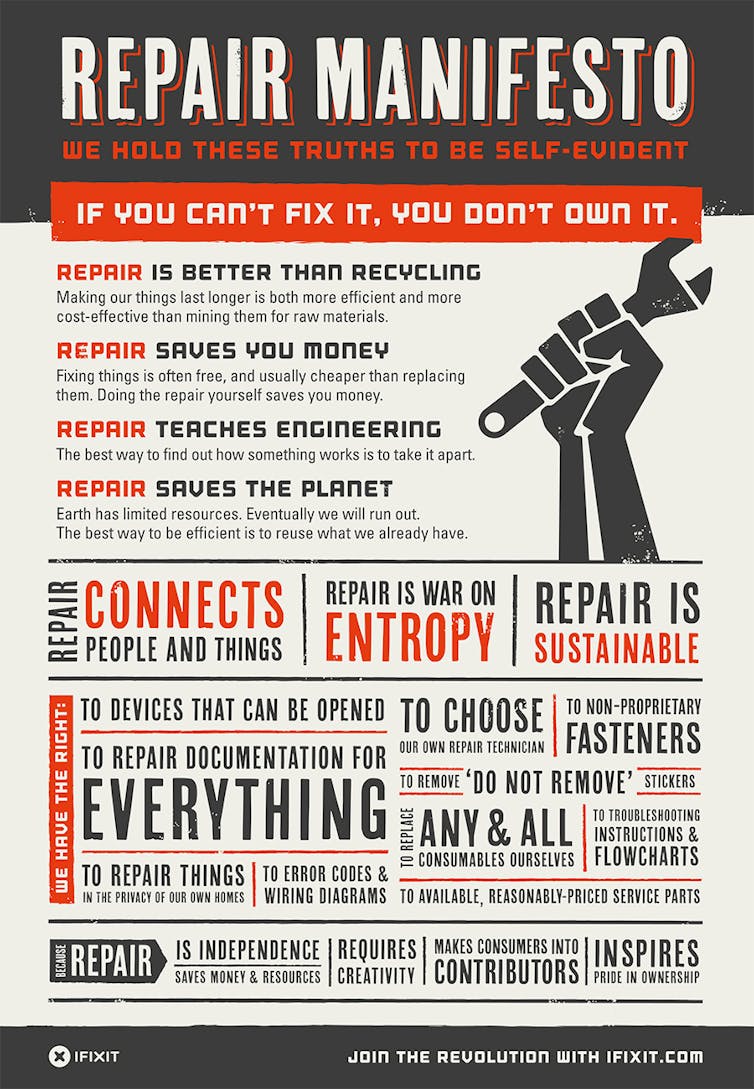
Not so long ago, when you purchased many different types of product, they would come with handy instructions on how to repair and extend a product’s life. Now they come as hermetically sealed units, unavailable replacement parts and with dire health and safety warnings on the dangers of tampering. But the tide is imperceptibly turning as we become more resistant to the throwaway culture. A really nice article about the restorative human qualities that emerge when repairing things becomes much more than just about extending the life of your kettle.


Author: By Katherine Wilson, Swinburne University of Technology.

John switches on the power saw he’s bought secondhand on eBay. The machine “arcs” – shooting out a visible electric charge. So he takes it apart to investigate. He identifies the problem: the field coil, a current-carrying component that generates an electric field. Once fixed, the saw works as new.


I met John during my doctoral research into tinkerers — people who love to adapt and repair things. But many things have become harder to fix.


Just a few decades ago, manufacturers packaged everyday appliances with instructions on how to repair them. Now they come with danger warnings and threats that doing so will void the warranty.


Repair is discouraged by unavailable replacement parts, glued assemblies and tamper-proof cases that are difficult to open. So we discard things rather than fix them.


Much research suggests this harms more than the natural environment. It also affects our mental environment. There’s a connection between the way society treats material objects and the way it treats people.

Returning to an economy of repair could help create a kinder, more inclusive society. By mending broken things we might also help mend what’s broken in ourselves.

Repair is an investment of ourselves

The environmental case for a repair economy is obvious. It saves natural resources and reduces waste.

There’s also a strong economic case. In his book Curing Affluenza, Australian economist Richard Denniss argues a community that repairs its goods “would employ more people, per dollar spent, than a community that instinctively disposes of them”. It would create more high-skill jobs and reduce the cost of living.

The social case is as strong. As Europe starts banning the disposal of unsold and returned consumer products, a mounting body of research shows that repair economies can make people happier and more humane.

During research for my 2017 book Tinkering: Australians Reinvent DIY Culture, I learned how material repair generates a deep sense of care, pride, belonging and civic participation.

Even solitary acts of repair involve a community of influences. Through acts of repair we experience products as expressions of our collective knowledge. Repaired products become bearers and extensions of personhood: like genomes, they carry their pasts within their presence.

By contrast, product obsolescence “blocks our access to the past”, argues Francisco Martínez, an ethnographer at the University of Helsinki. His research found repair was “helping people overcome the negative logic that accompanies the abandonment of things and people”. Repair made “late modern societies more balanced, kind and stronger”. It was a form of care, of “healing wounds”, binding generations of humanity together.

Like Polish sociologist Zygmunt Bauman, Martínez draws parallels between the displacement and neglect of objects and those of people.

In Estonia, Martinez says, repairing things “establishes continuity, endurance and material sensitivity” in a society disrupted by Soviet-style socialism and subsequent transition to capitalism:

Contemporary mending and the reluctance to dispose of material possessions can also be a way to resist dispossession and adapt to convoluted changes; the act throwing away is perceived as a threat to memory, to security, and to historical and ecological preservation.

Similar observations have been made in different economies.

Studying Londoners living in reviled council flats following the Thatcher years, British anthropologist Daniel Miller observed residents who fixed their kitchens. Those with strong and fulfilling social relationships were more likely to do so; those with few and shallow relationships less likely.

Miller is among many scholars who have observed that relationships between people and material things tend to be reciprocal. When we restore material things, they serve to restore us.

Right to repair movement

Repair economies don’t regard material things as expendable. They relocate value in the workings, relations and meanings of things. By contrast, consumer economies encourage us to relate with products in ways that damage the planet and promote a kind of learned helplessness.

www.ifixit.com

Initiatives include community tool libraries and repair cafés, where people take their broken things, share tools and get expert guidance on how to fix them. There are swap-meets, Remakeries, Mens’ Sheds, visible mending workshops, Hackerspaces, Restart Parties and Commons Transitions enterprises.

Such “glocal” — at once global and local — initiatives reinscribe humane values into mass culture. They encourage participatory citizenship and create informal exchanges of knowledge, skills, materials, goodwill and values. They create what sociologists call cultural capital, the benefits of which are recognised in public health funding of initiatives such as Men’s Sheds.

In Europe, environment ministers are pushing laws obliging manufacturers to make appliances repairable and enduring. Many US states are considering “fair repair” laws, and federal authorities have deemed it unlawful for phone and other tech manufacturers to prevent owners repairing their products. In Australia, state governments are considering ways to promote a “circular economy”, in which material resources circulate for as long as possible.

Briefings

Mending society

<p>Not so long ago, when you purchased many different types of product, they would come with handy instructions on how to repair and extend a product&rsquo;s life. Now they come as hermetically sealed units, unavailable replacement parts and with dire health and safety warnings on the dangers of tampering. But the tide is imperceptibly turning as we become more resistant to the throwaway culture. A really nice article about the restorative human qualities that emerge when repairing things becomes much more than just about extending the life of your kettle.</p> <p class="MsoNormal">&nbsp;</p>


Author: Katherine Wilson, Swinburne University of Technology.

John switches on the power saw he’s bought secondhand on eBay. The machine “arcs” – shooting out a visible electric charge. So he takes it apart to investigate. He identifies the problem: the field coil, a current-carrying component that generates an electric field. Once fixed, the saw works as new.

I met John during my doctoral research into tinkerers — people who love to adapt and repair things. But many things have become harder to fix.

Just a few decades ago, manufacturers packaged everyday appliances with instructions on how to repair them. Now they come with danger warnings and threats that doing so will void the warranty.

Repair is discouraged by unavailable replacement parts, glued assemblies and tamper-proof cases that are difficult to open. So we discard things rather than fix them.

Much research suggests this harms more than the natural environment. It also affects our mental environment. There’s a connection between the way society treats material objects and the way it treats people.

Returning to an economy of repair could help create a kinder, more inclusive society. By mending broken things we might also help mend what’s broken in ourselves.

Repair is an investment of ourselves

The environmental case for a repair economy is obvious. It saves natural resources and reduces waste.

There’s also a strong economic case. In his book Curing Affluenza, Australian economist Richard Denniss argues a community that repairs its goods “would employ more people, per dollar spent, than a community that instinctively disposes of them”. It would create more high-skill jobs and reduce the cost of living.

The social case is as strong. As Europe starts banning the disposal of unsold and returned consumer products, a mounting body of research shows that repair economies can make people happier and more humane.

During research for my 2017 book Tinkering: Australians Reinvent DIY Culture, I learned how material repair generates a deep sense of care, pride, belonging and civic participation.

Even solitary acts of repair involve a community of influences. Through acts of repair we experience products as expressions of our collective knowledge. Repaired products become bearers and extensions of personhood: like genomes, they carry their pasts within their presence.

By contrast, product obsolescence “blocks our access to the past”, argues Francisco Martínez, an ethnographer at the University of Helsinki. His research found repair was “helping people overcome the negative logic that accompanies the abandonment of things and people”. Repair made “late modern societies more balanced, kind and stronger”. It was a form of care, of “healing wounds”, binding generations of humanity together.

Like Polish sociologist Zygmunt Bauman, Martínez draws parallels between the displacement and neglect of objects and those of people.


In Estonia, Martinez says, repairing things “establishes continuity, endurance and material sensitivity” in a society disrupted by Soviet-style socialism and subsequent transition to capitalism:

Contemporary mending and the reluctance to dispose of material possessions can also be a way to resist dispossession and adapt to convoluted changes; the act throwing away is perceived as a threat to memory, to security, and to historical and ecological preservation.

Similar observations have been made in different economies.

Studying Londoners living in reviled council flats following the Thatcher years, British anthropologist Daniel Miller observed residents who fixed their kitchens. Those with strong and fulfilling social relationships were more likely to do so; those with few and shallow relationships less likely.

Miller is among many scholars who have observed that relationships between people and material things tend to be reciprocal. When we restore material things, they serve to restore us.

Right to repair movement

Repair economies don’t regard material things as expendable. They relocate value in the workings, relations and meanings of things. By contrast, consumer economies encourage us to relate with products in ways that damage the planet and promote a kind of learned helplessness.

www.ifixit.com

Initiatives include community tool libraries and repair cafés, where people take their broken things, share tools and get expert guidance on how to fix them. There are swap-meets, Remakeries, Mens’ Sheds, visible mending workshops, Hackerspaces, Restart Parties and Commons Transitions enterprises.

Such “glocal” — at once global and local — initiatives reinscribe humane values into mass culture. They encourage participatory citizenship and create informal exchanges of knowledge, skills, materials, goodwill and values. They create what sociologists call cultural capital, the benefits of which are recognised in public health funding of initiatives such as Men’s Sheds.

In Europe, environment ministers are pushing laws obliging manufacturers to make appliances repairable and enduring. Many US states are considering “fair repair” laws, and federal authorities have deemed it unlawful for phone and other tech manufacturers to prevent owners repairing their products. In Australia, state governments are considering ways to promote a “circular economy”, in which material resources circulate for as long as possible.

Briefings

Allotments need to be planned

<p>Allotments seem to suffer from a problem of perception. Even in today&rsquo;s policy climate in which food growing is increasingly prominent, and with the prospect of new legislation being brought forward to confirm Scotland as a Good Food Nation, the evidence suggests that most local authority planners still regard food growing simply as a leisure activity and as such fail to prioritise food growing when considering land use in local plans. While highlighting some notable exceptions in Aberdeenshire and East Lothian, <span style="text-decoration: underline;"><span style="color: #1155cc;" data-mce-mark="1"><a href="http://www.sags.org.uk/"><span style="color: #1155cc;" data-mce-mark="1">SAGS </span></a></span></span>have just published a nicely illustrated guide for the rest of the country&rsquo;s planners.</p> <p class="MsoNormal">&nbsp;</p>


Author: SAGS

The Scottish Allotments and Garden Society are pleased to announce the publication of a  ‘Plan to Grow – A Planning Guide for Allotments’, author Steven Tolson, Consulting.  The intention of this guide, funded by Awards for All Scotland part of the National Lottery, with help from Planning Aid Scotland is to help inform Scottish Local Planning Authorities about the importance of food growing in our local communities.  Further copies of this report along with a more detailed report are available as downloads from our website


The Society and its members are aware that proposals within the current Planning Bill are for local communities to have a greater role in the planning process including the development of ‘Local Place Plans’.  As an organisation we are very supportive of the planning commitment to a ‘plan led’ approach and creating better and healthier Scottish places.  Clearly, we believe to achieve better places there needs to be a commitment to providing more land for growing local food.  

Such a commitment is wholly in line with the Scottish Government’s aspirations to become a ‘Good Food Nation’ by 2025.  The Scottish Food Industry is a very important part of the Scottish economy and local non-commercial food growing production should be recognised for its growing contribution.  The ‘Plan to Grow’ guide makes some important points about the wider health and well-being benefits of food growing for individuals and crucially argues that growing one’s own food makes a significant contribution to social interaction and cohesive communities.  As you know such attributes are all part of a spatial planner’s tool kit.

With the enactment of the Community Empowerment (Scotland) Act 2015 legislation now being exercised by communities across Scotland, the provisions of the Act will have an increasing influence on the way local development plans are prepared and agreed.  Specifically, the provisions of Part 9 of the Empowerment legislation along with the supporting guidance highlights the roles and responsibilities of local authorities in the provision of land for food growing and its future management.  To this end, as key land management professionals, the Guide argues that Planners will inevitably have an important role to play in identifying and facilitating more land for food growing as part of the wider objective of making better places for Scotland.

The Scottish Allotments and Gardens Society hope that the Guide will assist you and your planning colleagues in developing policies for local food growing that achieve a wide beneficial impact for Scottish community well-being.

Briefings

Lotto lunacy

<p>It&rsquo;s 25 years since Mystic Meg first enticed the nation to part with its hard earned cash in the hope of winning the National Lottery jackpot (current chance of winning Lotto - <span style="font-size: 9pt; line-height: 107%; font-family: Arial, sans-serif; background: #f8f9fa;" data-mce-mark="1">45,057,474 to 1). </span>The early assurances that Lottery funds would only ever be used to add value to mainstream public funding - and never to replace it - has long since been forgotten. There are so many lottery schemes on the go today that it&rsquo;s hard to keep up with. Now plans are being laid to launch a local authority lottery scheme. Is there no end to it?</p> <p class="MsoNormal">&nbsp;</p>


Author: Improvement Service

A community lottery for Scottish local government

For a number of months, the Improvement Service has been facilitating discussions with councils on the potential to establish a local authority lottery scheme.

This is possible within current council powers and has been successfully pioneered by a growing number of local authorities in England.

In summary, council lotteries offer the potential to generate income for distribution to ‘good causes’ – normally via local community and voluntary groups. This can link to existing local mechanisms such as participatory budgeting.

A number of Scottish councils are already well advanced in developing a lottery scheme and are keen to explore the potential benefits of a collaborative management approach across a number (and potentially all) Scottish local authorities. This would be within the context of developing discrete area-based lotteries which distribute benefits locally.

We will be sending further information around the next stage of this work to all council chief executives over the next few weeks.

Briefings

Tackling depopulation

<p>Without some kind of intervention, population levels across large swathes of rural Scotland are set to fall drastically in the coming years. That&rsquo;s the inescapable conclusion of research published last year by the James Hutton Institute and backed up by projections from Highland Council. If communities in the most remote parts of the country are ever to be sustainable in the long term, it seems inevitable that more positive action from Government will be required. While Community Land Scotland&rsquo;s policy director Calum MacLeod thinks the new Planning Bill might help, he is unequivocal about what really needs to happen.</p> <p class="MsoNormal">&nbsp;</p>


Author: Calum MacLeod

The Planning (Scotland) Act 2019 and Rural Repopulation

The Scottish Parliament recently passed the Planning (Scotland) Act 2019 after three days of intense and increasingly acrimonious debate in the Chamber.  The Bill was originally envisaged by the Scottish Government as a measure to streamline the land use planning system.  Instead, it became a legislative ‘free for all’ as MSPs from all parties weighed in with well over 300 amendments;  the highest total ever tabled for a Bill progressing through its legislative stages at Holyrood and a reflection of the political importance of the planning system as something that both directly and indirectly affects people’s everyday lives.  Not all of these amendments survived the Bill’s protracted and occasionally stormy passage, with  the Greens, Labour and Liberal Democrats voting against it becoming law while the SNP and Conservatives voted in favour.

Amongst other things, the new Act sets in statute for the first time the purpose of planning as being to manage the development and use of land in the long term public interest. It sets out issues for consideration in developing both the next National Planning Framework (NPF) which is the long-term spatial plan for Scotland and future Local Development Plans  formulated by Planning Authorities.  The Act also introduces provisions for Local Place Plans, envisaged as enabling communities to have a stronger say in deciding how their local areas are developed and Masterplan Consent Areas to more readily facilitate development in specified areas.

Several amendments that did survive the cull relate to rural repopulation and resettlement, and reflect much of what Community Land Scotland – the membership organisation for Scotland’s community landowners – called for in its evidence submission on the draft Planning Bill back in January 2018.   Community Land Scotland’s proposals for rural repopulation and resettlement drew considerable media attention at the time.  Amongst the more excitable headlines was that of one national newspaper proclaiming “Lairds warn against plans to reverse Clearances”.   Pause for a moment to contemplate the rich seams of irony contained within these words.

The Planning (Scotland) Act 2019 makes several explicit links between rural repopulation, land reform and the continuing evolution of Scotland’s planning system.  Increasing the population of rural areas of Scotland is included as one of four outcomes for the National Planning Framework. Scottish Ministers must have regard to the desirability of resettling rural areas that have become depopulated when preparing the content of the Framework and allocating land for resettlement may now be a consideration for developing both the NPF and Local Development Plans. Preparation of the next NPF will also include scope for producing maps and other material relating to rural areas where there has been a substantial decline in population.  The Framework must have regard for any Land Rights and Responsibilities Statement or any strategy for land ownership or use prepared by Scottish Ministers.  There are also provisions in the new Planning Act about reporting on and improving consultation with communities in relation to the designation of any new National Scenic Areas.

These amendments matter because of the depopulation crisis that great swathes of rural Scotland – and particularly the Highlands and Islands – face.  In 2018 the James Hutton Institute published research indicating that, “in the absence of intervention”, Scotland’s Sparsely Populated Area (SPA), covering almost half of Scotland’s land area but containing less than 3% of the nation’s population, faces losing more than a quarter of its population by 2046; a decline which “implies serious challenges for economic development, and consequences for its landscape and ecology which are poorly understood”.  Similarly grim projections are contained in The Highland Council’s Corporate Plan for 2017-2022 which was updated earlier this year.  Inverness, Skye and Lochalsh, and Ross and Cromarty are projected to see their populations increase between 2016 and 2041.  Yet many other places in the region are set to see their populations continue to spiral downwards during the same period: Sutherland (-11.9%); Caithness (-21.1%); East Ross (-13.8%); Badenoch and Strathspey (-5.3%); and Lochaber (-5.9%). 

The rural repopulation and resettlement provisions contained in the new Planning Act can help reconfigure the planning system as an effective policy tool to help address the litany of depopulation facing much of the Highlands and Islands and elsewhere in rural Scotland.  However, the effects of these provisions will inevitably take time to come to fruition, given that the next iterations of both the National Planning Framework and of Planning Authorities’ Local Development Plans lie some way into the future.   They also depend on the commitment of Government and Planning Authorities to drive the planning system towards land use that is genuinely sustainable in helping deliver the affordable housing, physical and services infrastructure and high quality jobs that are vital in helping to retain and attract more people to live and work in our rural places.

The planning system is ultimately a single piece – albeit an influential one – of a policy jigsaw that urgently needs to be assembled for Scotland’s sparsely populated rural places to flourish.  Part of the challenge lies in reframing our relationship as a society with land and landscapes in ways that enable our rural communities to exist and thrive as a matter of social justice while simultaneously safeguarding our natural heritage. 

Land reform, defined in the Land Reform Review Group’s 2014 report, ‘The land of Scotland and the common good’, as “measures that modify or change the arrangements governing the possession and use of land in Scotland in the public interest” has a vital role to play in reframing that relationship.   However, its relevance as a cross-cutting theme to advance sustainable rural development has yet to fully penetrate the siloed structures of Government if ‘A new blueprint for Scotland’s rural economy: recommendations to Scottish Ministers’, a report issued in September 2018 by the National Council of Rural Advisors is any guide.  That influential document in shaping Government thinking on the rural economy mentions land precisely once in calling for development of “ecosystems services and climate change mitigation actions that reflect best land use-practice”. There is not a single mention of the significance of land ownership as a driver for rural development or of land reform more generally. 

Such omissions are perplexing, particularly in light of the Scottish Land Commission’s subsequent research report in March of this year highlighting abuses of power as a result of concentrated land ownership in Scotland.  The Commission’s report highlights “fear of repercussions from “going against the landowner” expressed by some people.  This fear was rooted firmly in the concentration of power in some communities and the perceived ability of landowners to inflict consequences such as eviction or blacklisting for employment/contracts on residents should they so wish”.   This is testimony given to the Land Commission in 21stcentury Scotland. You’d be forgiven for mistaking it for evidence to the Napier Commission of the 1880s, so shockingly does it collide with our self-image as a socially progressive nation.

It’s clear that rural communities in Scotland’s sparsely populated areas face a crisis of depopulation that threatens their very existence in the longer term.  Provisions contained in the Planning (Scotland) Act 2019 offer encouragement that the planning system has an important role to play in tackling that crisis if there is genuine will on the part of Government and Planning Authorities to implement them effectively.  But much more needs to be done.  If we are serious about addressing rural depopulation then land reform in its broadest sense, encompassing changes to both land ownership and land use in the public interest, needs to be front and centre in future rural policy development as a matter of social justice.

By coincidence, there’s an opportunity to start doing exactly that.  A couple of weeks ago the Scottish Government announced the creation of a Ministerial Task Group on Population, chaired by Fiona Hyslop, Cabinet Secretary for Tourism, Culture and External Affairs with a remit to “consider Scotland’s future population challenges and develop new solutions to address demographic and population change”.  The extent to which the Task Group takes up the policy cudgels on behalf of rural communities imperilled by depopulation will provide an early indication of where their needs sit in the policy pecking order.

Briefings

Where the greater good is served

<p>In the heritage and museum world (of which I have very little experience except as a visitor) there must be a lot of debate about how and where any heritage collection should be displayed. And the heat of those debates probably increases when the collection of pieces to be shown is considered of great national importance. An interesting reflection on this from an archaeologist from Dundee Uni on her work with a community in a remote region of Alaska. Her experience caused her to completely revise her ideas on where the &lsquo;greater good&rsquo; is served.</p> <p class="MsoNormal">&nbsp;</p>


Author: Alice Watterson, Dundee University

The Yukon-Kuskokwim Delta region of Alaska is home to the Yup’ik people, who practise a largely subsistence lifestyle characterised by seasonal hunting, fishing and gathering. An archaeological dig happens here each year over the brief summer season between July and August, although seasonal changes, once like clockwork, are becoming less distinct because of climate disruption.

The dig, which goes back nearly a decade, was initiated by the local community with the aim of rescuing the remains of an old sod house in a nearby area known as Nunalleq, or “the old village”, before it is lost to permafrost melt and a crumbling coastline. The site dates from between 1570 and 1675, decades before Yup’ik first came into contact with Russian and European traders.

The excavations, led by a team from Aberdeen University in Scotland, were well underway by the time I joined in 2017. The project has recovered some 100,000 artefacts which were put on public display for the first time in August 2018 at the Nunalleq Culture and Archaeology Centre in Quinhagak.

As a reconstruction artist, it is my job to translate archaeological findings into renderings of life in the past. In Quinhagak, I was tasked with collaborating with the local community to co-design a digital resource for schoolchildren. It tells the story of the excavations in a way that makes space for the traditional Yup’ik worldview and contemporary parallels in subsistence, dance and crafts.

 Within this resource, 3D-scanned artefacts and animated reconstructions of village life at Nunalleq can be explored on a computer screen, accompanied by soundbites, videos and interactive content co-curated by the Quinhagak community and the archaeologists. It will be available to the public here from July 2019.

The purpose of my trip in April 2019 was to test the resource on school computers in the village. This trip was outside the usual dig season so I stayed with a local family. My host was schoolteacher Dora Strunk, who was raised in Quinhagak and whose children belong to a generation in the village who grew up with the archaeology project.

Whether it was bouncing across the tundra on Dora’s four-wheeler to collect kapuukuq greens, or sitting in her daughter Larissa’s bedroom listening to her explain the meaning behind her traditional dance regalia, these friendships have gradually reshaped my own understanding of what it means to be Yup’ik in the 21st century.

What heritage means

I’ve heard objections to the collection being housed in the village: shouldn’t it be in a big museum in Anchorage or New York where more people can see it, “for the greater good”?

What I have learned during my visits here is that there is a need to maintain heritage within a community – and to allow it to be part of the here and now. Heritage is often seen as being focused on fragmented artefacts and ruinous buildings, but for many people, particularly indigenous and descendant communities, it can be intrinsically connected to a sense of social identity and cohesion.

Like many indigenous communities across the world, Yup’ik are still dealing with the effects of deep historic trauma from centuries of colonisation, exploitation and misrepresentation. Yet unlike the majority of Native Americans in the lower 48 states, Alaska Native land isn’t compacted into Indian reservations. People still traverse the vast expanse of tundra and coastline like their ancestors did thousands of years ago.

That said, maintaining this connection to land and tradition does not constitute a bygone era. Yup’ik is a living culture fully part of the modern world, with Snapchat and drum dances, microwave pizza and walrus ivory carving, snow machines and subsistence practices – even Facebook feeds filled with Yup’ik memes. Culture persists.

Establishing the Nunalleq centre in Quinhagak and helping to create the digital resource with the Yup’ik community is part of the same mind set that is prompting a handful of museums to repatriate artefacts and remains to descendant communities – while others come under mounting pressure to do so.

My latest trip coincided with the district’s annual dance festival, which brought together schools from across the region. I had worked with young people from the local group the previous summer, who had chosen to interpret the excavation of dance regalia from Nunalleq by writing a new traditional drum song or yuraq about the site. They performed it again at this year’s festival.

During the festival, many youngsters came to the museum to see the artefacts. I witnessed teenagers pulling open drawers containing wooden dance masks, drum rings, ivory earrings, bentwood bowls and harpoons with trembling hands. Big kids lifted little kids up to peer into the cabinets and gasp, asking: “These all came from down there? From our beach?”

The “greater good” is right here: not only the collection being housed in Quinhagak, but also the work the village is doing to take charge of its story and share it with the wider world through outreach like the Nunalleq Educational Resource.

For Quinhagak, the past is not a place which is independent from the present. For the younger generation especially, the past is becoming a space for engaging with their heritage which they are continually transforming and reimagining in the present.