News

Growing community wealth with food and love in Midlothian

December 5, 2025

In Mayfield and Easthouses, the local development trust is using food to feed the soul of the community. With a community pantry, café, and a derelict bowling green transformed into a thriving community garden, they are defining what Community Wealth Building looks like.

By Lucas Batt & Rhiannon Davies, Greater Community Media


Sharon Hill is one of those people who just makes things happen. It’s no coincidence she runs Mayfield and Easthouses Development Trust (MAEDT), which locals pronounce “Made It”. Their slogan is “Making it Happen”, and Sharon and her team have been doing exactly that for the past ten years.

They serve a semi-rural ex-mining community outside Edinburgh, long affected by unemployment, health inequalities and chronic underinvestment. The area remains one of the most deprived in Midlothian. But today, if you walk into MAEDT’s lush and vibrant community garden, the story is one of care, connection and hope.

“Previously this was a bowling green that hadn’t been used for a very long time,” Sharon says, gesturing at the thriving garden. “The grass was waist high, the building was boarded up.” 

The green had been disused for decades, and the pavilion, shut after asbestos was found, was used by the council to store broken gym equipment. Back then, MAEDT had no centre for the community. The leisure centre had been flattened with leisure services moved to a newly built school, but there was no physical place for the community to call their own.  Despite being in the local development plan, there was no money for it.

Sharon wasn’t going to wait forever. She was going to make it happen. So MAEDT gradually moved into the bowling green and started to bring it back to life, serving teas and coffees around the broken treadmills.

It’s now a bustling village square – a place of safety and abundance.

Food is the key

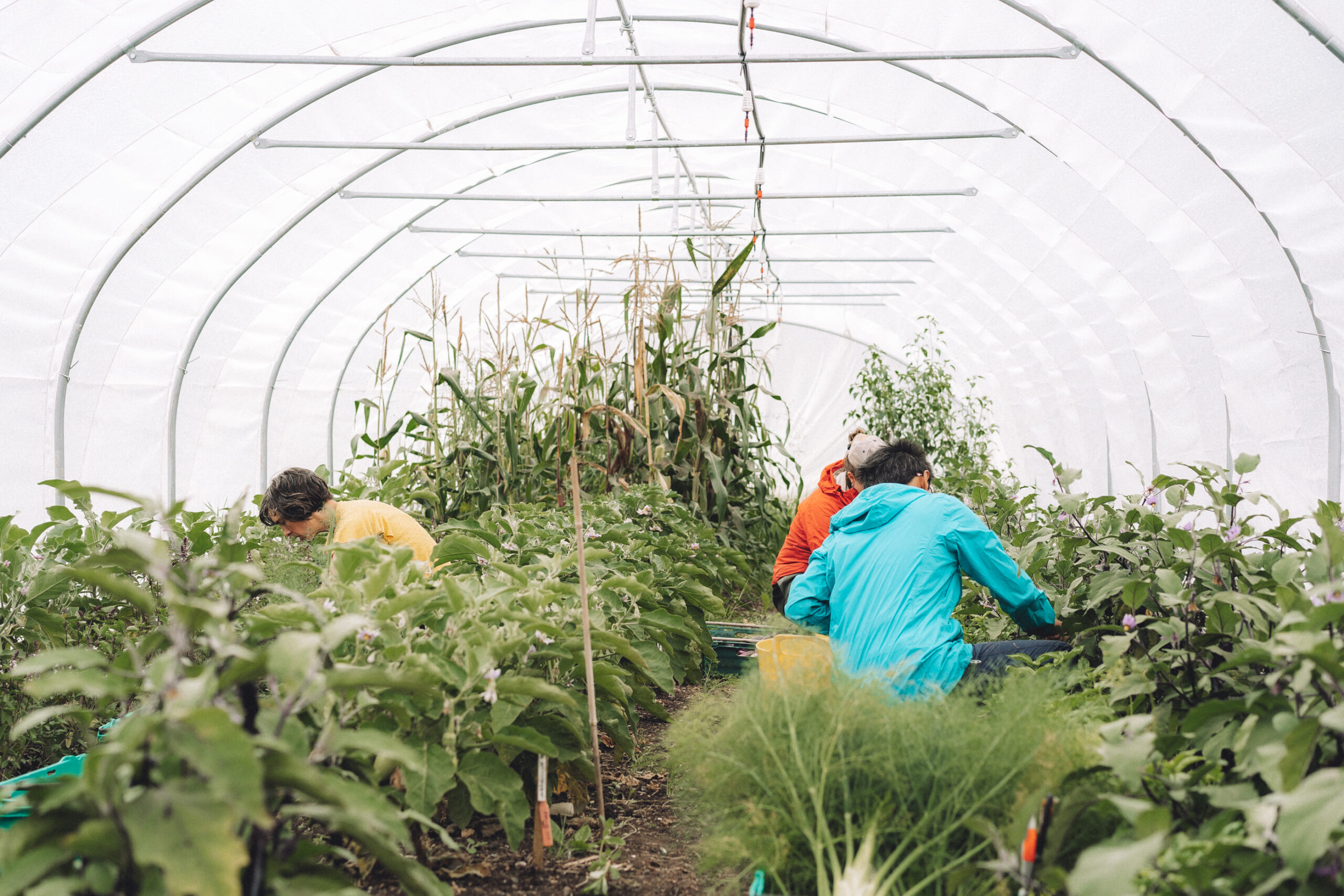
Sunflowers loom over rows of pumpkins, with deep green kale swathed in netting to save it from the slugs. Raspberry bushes sway beside small fluttering wind turbines set against the polytunnel. Inside it’s bursting with life, rich with the scent of ripening tomatoes, arches of grapevines hang over a cosy seating corner, where people can retreat for a quiet moment amongst the plants.

Outside, a cluster of High School bee-keepers buzz around the hives, while nursery children learn how to grow vegetables. The once derelict pavilion now hosts a busy community café, where an older people’s walking group sits down to hot vegetable soup fresh from the garden. Across the road, MAEDT’s community pantry provides dignified access to good food for hundreds of residents.

“We’re growing food, we’re cooking food, we’re providing food,” says Phil Morris, who manages the pavilion and the garden, balancing jobs tending plants, teaching children, building and mending things, supporting volunteers, and everything in between.

Food is at the core of MAEDT’s philosophy. “When you feed someone, you’re nurturing them,” says Sharon. “Food loosens people’s tongues. If you’re eating soup, you’ll tell me things you wouldn’t mention anywhere else. You find out someone is sleeping on the floor because they don’t have a bed. And because we built that trust, we can help.”

The turning point

The pandemic changed everything. MAEDT stepped up when statutory services struggled to reach those most in need.

“They had to trust community organisations to do stuff. We were the ones on the ground,” recalls Sharon. “We were the ones peeling tatties and delivering food. We were the ones picking up prescriptions.”

Working with the Chair of the local Community Council to lead a team of volunteers on furlough, they cooked and delivered 250 two-course hot meals a day to isolated residents. But they delivered more than food. “I used to say to the volunteers, ‘remember, you’re not delivering mince and tatties. You’re delivering a wee bit of care, a wee bit of love.’”

MAEDT was there in this moment of crisis when people in the community didn’t know who to turn to. Sharon found herself fielding calls from people worried about their elderly parents, and from people who had never engaged with support services before, who suddenly found themselves with nothing to eat. “These people were mortified, ashamed,” she says. “I was getting people phoning me up who had never had to ask for help before.”

By showing up, responding to these calls with food and kindness, MAEDT earned something money can’t buy: absolute community trust and respect.

Dignity, not charity

Speaking with people every day meant MAEDT really understood their needs. They recognised that the need for access to affordable and healthy food wouldn’t end with lockdown. So they created the Community Pantry. Unlike a food bank, where parcels are pre-packed and choice is limited, the pantry operates like a shop. For £3.50 a week, residents can choose £15-£20 worth of food, as well as free fresh fruit and vegetables, sanitary products and bread

“The difference between us and a food bank is choice,” Sharon explains. “And dignity. It’s a community pantry, not a poverty pantry. If you get a food parcel, you get tins of beans. If you come here, you can choose what you want to eat. You can give your kids a Nando’s on Friday night.”

The pantry has been a runaway success: 1,300 households have signed up in four years in a community of only 2,500 homes. Around 180 people shop there every week – some to help stretch tight budgets, some in crisis using it to survive. But because everyone shops together, there is no stigma.

MAEDT has also become a hub for other support. They host space for Citizens Advice sessions, skills training, career support, a school uniform exchange, and a £1 charity shop. They also step in with emergency funds, helping people with everything from beds and washing machines to electricity bills and nursery fees. These small acts are little miracles for people.

The wealth of belonging

If Community Wealth Building means anything, it means this. It is not about simple economics, but the health and wellbeing of a community. As Sharon puts it beautifully: “The wealth of the community is in the actual community.”

And data backs her up. A recent Social Value Engine analysis found that for every £1 invested in MAEDT, they generate £9.90 in value for the community. “If feelings had a value, we came out being worth £4.5 million to our local economy,” Sharon notes. “If belonging, empowerment, connection and reduced isolation were given a monetary value, we give ten times what people give us.”

Their success comes from the honesty, respect and trust they give their community. And they receive this in return. They don’t have problems with shoplifting or graffiti. Instead they receive a constant stream of donations and volunteers.

MAEDT is theirs. They are not presented with a finished product, but invited to make it better together. “They’ve seen it grow in response to what they’ve wanted,” says Sharon. They know there won’t suddenly be a huge influx of money, so they are building the kind of wealth they can, and that ultimately matters to people: the wealth of belonging.

Networks for growth

MAEDT hasn’t done it alone. Backing this community stand funders, networks and intermediary organisations. 

When Sharon first eyed the bowling green, she knew she was out of her depth. “I did not have a clue about gardening or growing food,” she laughs. “I was looking for pals.” 

She found them in Get Growing Scotland. They helped to plant the vision for the garden, from ideas for its layout to growing through the pandemic. Drawing on their work with communities across Scotland, they brought a unique set of knowledge that proved invaluable. Today, the garden stands as an exemplar for other communities looking to grow their own spaces.

Karen Moore from Get Growing reflects that every community needs more pioneers like Sharon: “They’re able to look out their window and see a piece of land and realise that’s what Community Wealth Building is, or can be – putting a literal stake in the ground and turning an unused space into a place where people meet, grow food, learn skills and connect.

For organisations like MAEDT, working on the front line of building wealth in their communities, intermediaries like Get Growing and Development Trusts Association Scotland (DTAS) are vital. They advocate for them, provide advice and expertise on everything from business plans to Community Asset Transfers. Or just to lay the foundations of a garden. They enable them to have the confidence and knowledge they need to achieve their visions with their communities.

“We work on the ground, directly supporting communities to secure and develop land, grow food and renew nature,” says Karen, “We harness their experiences and learning from across the country, share inspiration, innovation and practical ways to build community wealth for all.”

Funding the whole alphabet

But no amount of support can fix the broken funding model. Despite MAEDT’s undeniable success, they operate on a knife-edge, suffocated by bureaucracy and insecure funding.

“I need funding that doesn’t leave me in September thinking that in April I have no funding,” Sharon says with frustration. “The longest we’ve had is three years, and three years passes in the blink of an eye.”

Short-term funding doesn’t mean short-term work, but long-term insecurity. MAEDT keeps doing what the community needs long after project funding ends. “We’re funded to do A, B and C. Then A runs out, but we still do A because the community needs it. Before we know it, we’re doing the whole alphabet and we’re only funded for X, Y and Z.”

Spending so much valuable time chasing grants instead of delivering services is exhausting and inefficient, and erodes their capacity to invest long term and build the community wealth they are capable of.

“Treat us the same way we treat our community”

As Scotland debates the Community Wealth Building Bill, MAEDT’s story offers a clear lesson: communities know what they need and they are capable of delivering it. They just need the trust and resources to do it.

Sharon’s vision for the future is ambitious: a regenerated town centre with the pantry as an anchor tenant, a new community hub, a dry bar and an arts centre which would “make us sustainable”. 

Sharon is the chair of the town centre regeneration group, but that plan needs £50m. Sharon jokes that she’ll have to be wheeled there with a zimmer frame by the time that happens. Meanwhile she’s getting on and building MAEDT.

What Sharon and her team are doing in Mayfield and Easthouses is how community wealth is actually being built. But it is against the odds, and relying on heroic efforts. To support this credible and viable approach, Sharon says the relationship between government and community needs to change.

“The attitude of the local authority is still very paternal,” she says. “The general attitude is that they’re in charge and they know better.”

Her message to ministers is simple: “Treat us the same way we treat our community. Trust us. We do this work because we truly want the best for people. Respect that expertise and value it. Our destinations are the same. Respect us and support us, but trust us to do what we do.”

In Mayfield and Easthouses, MAEDT is showing what Community Wealth Building looks like. The evidence is in the soil bringing new life, in the buzzing café bringing new friendships, it’s in the pantry shelves, in the bowls of soup, and sunny days in the garden. It’s in the community. They have built something remarkable from the grassroots up. Now, they need a system that supports them to keep growing.

“Why not?” Sharon asks, looking across the flourishing garden. “Why would we not expect this to be here? We should all expect good things, nice things. We’re all worth that.”


Read more from our series This is Community Wealth Building and what we’re calling for to support Community Wealth Building across Scotland.

News

From market days to hydropower: Community Wealth Building in Balerno

December 4, 2025

On the edge of Edinburgh, a village trust is using a farmers’ market, a hydro scheme and a former police station to stop their community becoming a sleeping suburb.

By Paul Fisher Cockburn


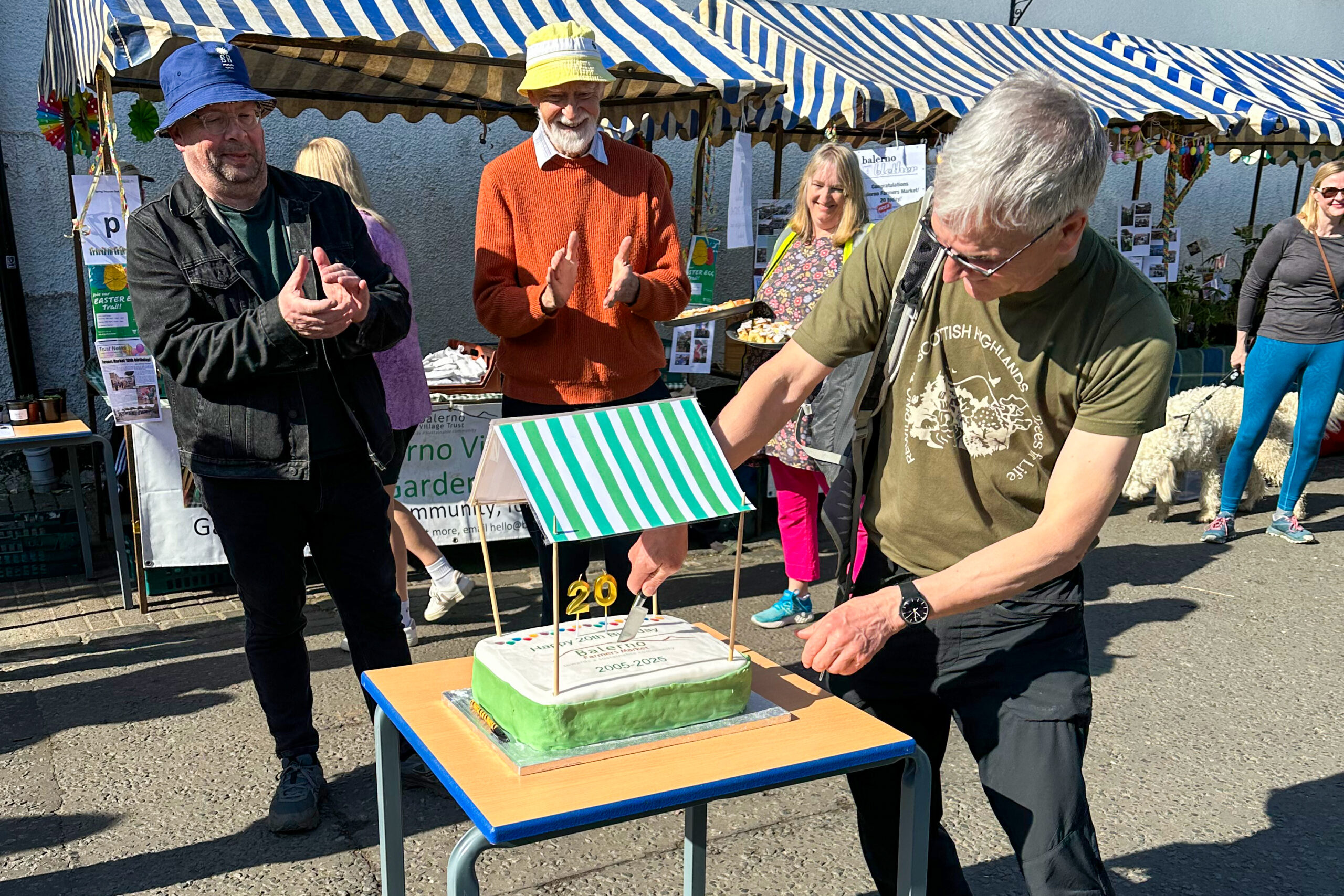
On the second Saturday of April 2025, the main street of Balerno was unrecognisable. Where cars usually rush through to the Pentland Hills, stalls crowded the road. The sun shone, and over the course of four hours, more than a thousand people flooded the street, buying fresh produce, meeting friends, and reclaiming the centre of their village.

It was the 20th anniversary of the Balerno Farmers’ Market. For the Balerno Village Trust (BVT), which runs the market, it was a celebration of two decades of Community Wealth Building. “The whole idea was to revitalise the Main Street,” says Emma Galloway, Chair of BVT. “To me it’s probably the biggest example of community wealth building,” she says.

Balerno sits on the south-western edge of Edinburgh. As a community, it risks becoming a dormitory village – a place where people sleep, but don’t really live.

“The challenge we’ve always had is that, if we’re not careful, Balerno could easily slip into the kind of place where people leave it in the morning, go in to the city to work, come back seven o’clock at night, go into their houses, shut the door, and that’s that. A suburb.” says Emma. “What we want is a thriving community where we know each other.”  

The economics of Main Street

The Trust’s strategy to prevent this is simple: make Balerno an even better place to live, work and visit.

The market acts as an economic anchor. On market days, footfall spills over. The local chemist is busy; the hardware store is busy. Money that might have leaked out to supermarkets or city centre chains stays in Balerno, circulating among local suppliers and businesses. 

“The whole theory of community wealth building is, if you can support small local businesses then actually the community benefits,” says Emma. “If you spend your money in a big supermarket, the profit goes to shareholders. If you spend it with a local supplier, the profit stays.”

They run special events to provide more reasons for people to come to Balerno and shop locally, with an annual Apple Day (celebrating “everything apple”) and Tattie Day (“about selling seed potatoes”).

The Market is also a well-established meeting place for local groups and organisations, ranging from local community council members to the district schools’ pipe band. “We have a number of organisations that will jump onto the market to raise their profile or to raise funds.”

“Community can talk with community,” says Emma. “If you want to know what’s going on in the community, come to the Market and you’ll get a sense of it.”

From events to assets

The Market may be a regular event on the second Saturday most months of the year but it’s also a temporary one, set up and taken down on the day. Since the Pandemic, however, BVT has become not just a property manager but also a property owner. 

In 2021, when the Balerno Community Centre faced an uncertain future, the Trust stepped in, recognising its importance as a community asset and meeting space. The City of Edinburgh Council offered them a decade-long lease for £10, on the condition that BVT upgraded the building.

They didn’t just paint the walls. They installed solar panels and air-sourced heating, transforming an aging liability into an environmentally friendly asset that now hosts a post office on Wednesdays.

But their most ambitious move was the purchase of the former Balerno Police Station, supported by the Scottish Land Fund. “When that went up for sale, we thought this was a real opportunity to try and find out what the village needs,” Emma recalls. “The village came back and said it was really struggling with childcare.”

For families in Balerno, the lack of local childcare is a major challenge. “To live in Balerno you pretty much need two incomes,” Emma explains. “We’re all working in the city as there aren’t that many local jobs. We need childcare, after-school care, nursery care. There simply isn’t enough provision in the village.”

BVT is currently working to select an after-school provider, while preparing to renovate the near-50-year-old building, which will offer several rentable rooms suitable for smaller groups and social gatherings—again, a rarity in Balerno. “Hopefully, it’ll create employment as well, because after-school clubs employ people. So there’ll be a bit more employment in the village.”

Generating their own wealth

A unique aspect of Balerno’s model is its funding. Because the village doesn’t tick many traditional funding boxes, grant funding can be hard to come by. Instead, they generate their own. BVT’s work is primarily funded by money from the local, community-owned Harlaw Hydro Scheme.

“We’re not an area of deprivation,” Emma accepts, “but we do have challenges. We have a higher population of retired people; we have the challenge of being technically urban but very rural – we are the end of the line, right at the edge of the City of Edinburgh. What we experience here – in terms of weather, in terms of bus services – can be vastly different to what people are experiencing in the centre of town.”

Powered by the community

When we spoke with Emma, Balerno Village Trust was about to take on its second employee, thanks to a National Lottery grant. A lot of its work nevertheless remains dependent on volunteers. 

“We’ve got really credible volunteers who have worked fairly high up in big international companies, who live in the village, and are willing to help,” says Emma.

“Part of the role of the new member of staff will be to harness that capability, because we recognise that we can’t just employ people. We don’t have the funds, and we won’t get the funding to employ people to run it for us, so we have to look at our own assets, our own strengths. What we have as a community are people nearing or heading for retirement, who have lots of credible skills and can give us a bit of their time.”

A need for recognition

Despite their success – running a market, managing a hydro scheme, renovating public buildings – Emma feels that the relationship with local government remains unbalanced. Community volunteers are often viewed as amateurs rather than partners.

“Sometimes we get a bit of an attitude: ‘Oh, you’re just volunteers, so therefore…’ and the dot-dot-dot is usually a belief that we don’t know what we’re doing,” she says.

“Actually, we do know what we’re doing. Give us the credibility, give us the respect, and work with us, and help us along the way.”

Networks behind the success

Behind success stories like Balerno stands national networks providing the essential scaffolding they need to thrive. Development Trusts Association Scotland (DTAS) is one of those networks. 

For community groups making the complex transition from volunteer committees to property owners and employers, DTAS provides specialist support through three core teams. Whether it is the Community Ownership Support Service helping navigate the legalities of asset transfers – like buying an old police station – or the Democratic Finance team advising on citizen investment for renewable energy projects, they ensure communities have the technical expertise to turn ambitious local visions into viable, professional businesses.

Pauline Smith, Chief Executive of DTAS, describes this role as ensuring communities can “do what they need to do, but with the support and advice to do it properly.” This involves asking tough questions about business planning and sustainability to ensure organisations succeed when taking on responsibilities like buildings or staff.

Beyond technical advice, DTAS acts as a crucial voice at a national level, lobbying the Scottish Government to recognise that these local interventions are not just ‘soft’ community projects, but hard economic drivers, creating genuine prosperity across Scotland.

“If you’ve got 400 communities all doing 10,000 activities, it doesn’t matter how small they are, together they make a massive impact,” says Pauline. “From a Community Wealth Building perspective this creates a huge multiplier effect across the country, creating massive economic impacts.”

The wealth of connection

“For us, the sign that it works is simple,” says Emma. “For us, it’s if people are standing there talking to each other, and there’s a sense of community cohesion being created. Life is better when you know other people, and you can walk down the street and have a wee chat with someone.”  

By taking control of their energy, their buildings, and their economy, Balerno is ensuring that it remains a place where people don’t just sleep, but truly live.

News

Rebuilding community wealth through land ownership: the story of Tarras Valley Nature Reserve

November 26, 2025

For the people of Langholm, the Tarras Valley has always been theirs. So when the land came on the market, they rallied to do the impossible and pulled off a 10,000-acre community buy-out. This is Community Wealth Building in action: local people taking ownership of their land and their future, securing Langholm Moor to create the Tarras Valley Nature Reserve for the benefit of generations to come.

By Lucas Batt & Rhiannon Davies, Greater Community Media
Drone footage: Inigo Alcaniz


On the ridge line of Whita Hill, overlooking the River Esk, there are stone cairns that have stood silent witness to centuries of history. Every year, for over 250 years, the people of Langholm have ridden out to these markers to check their boundaries – a tradition known as the Common Riding. Riding in their hundreds through packed streets, over a chorus of flutes and pipes, the din of hooves fade into the distance as they ascend the hills of the Tarras Valley. It is a visceral, proud assertion of belonging.

For generations, the land felt like it belonged to the community, even though the deeds were held by one of Scotland’s largest landowners, the Duke of Buccleuch. In 2019, that changed: the estate put the land up for sale.

“It caused quite a lot of shock, a lot of concern,” recalls Angela Williams, Development Manager at the Langholm Initiative. “For people, this was always theirs. It’s where they ride, swim, walk.. nobody knew what would happen if the community didn’t buy it.” Losing access was unthinkable. “People started asking the Langholm Initiative, as the main development trust in the town, what could be done about it.”

The people of Langholm are no strangers to taking things into their own hands. As Alan Weatherstone, Editor of the 175-year-old, community-owned Eskdale & Liddesdale Advertiser puts it: “There’s always been an element in Langholm of isolation and because of that isolation the psyche here is that we’ve got to do it ourselves, because they’re not going to come and do it for us, so we just have to get on and do it”.

The David and Goliath Buyout

The Langholm Initiative answered the call. For them, it felt like “David and Goliath,” says Chair Mairi Telford-Jammeh, engaging with one of Scotland’s biggest landowners. But Buccleuch listened. “Once Buccleuch realised the level of concern, they did sit down and, in principle, were supportive of the idea of looking at the community buying the land, albeit with timescales put on it,” says Angela.

The Initiative proposed the creation of the Tarras Valley Nature Reserve – regenerating land and strengthening the economy. The challenge was immense: raise £6 million in a little over 12 months, during the pandemic. But the campaign struck a chord. Nearly 4,000 people backed the crowdfunder, raising over £500,000. This, in turn, leveraged major support, including £2 million from the Scottish Land Fund and significant contributions from trusts, charities and private donors.

Against all odds, the community completed the buy-out in two tranches in 2021 and 2022, purchasing 10,500 acres. “This is a moment of history and hope,” said Estate Manager Jenny Barlow upon its completion. “It shows how communities can achieve the remarkable when people work together, even when the odds seem impossible.”

“Good for nature, good for people”

As a nature reserve run by a local community development trust, Tarras Valley is a major opportunity for Community Wealth Building – restoring land while generating long-term benefits for local people. The project is part ecological restoration, part rural regeneration.

“It was going to be good for nature, it was going to be good for climate, but more importantly, it was going to be good for people,” says Angela. “For us, it was looking at the land, seeing how it was valued by the local community and looking at what the ecological potential of it was. You look at it just much more holistically.”

Work is already underway. They are creating ponds, removing culverts, and restoring natural watercourses. Peatlands are being re-wetted: blocking ditches and re-profiling more than 30 miles of peat hags to prevent erosion and store carbon. Teams continue removing non-native Sitka spruce, planning new native woodland, and protecting hen harriers in partnership with local raptor groups. Unlike some rewilding models, they have retained the existing sheep farm whilst plans are developed to move to a regenerative  model that will include cattle and ponies

The buyout included nine properties, many of them tenanted. Derelict houses are being renovated into affordable homes, with a commitment to use local contractors wherever possible – investing around £100,000 a year into the Langholm economy.

Visitors now come for walking, wildlife, and education, supporting local hotels, shops and cafes. School projects, volunteering, and biodiversity monitoring bring residents of all ages into the Reserve.

Most importantly, the land is now secured as a community asset in perpetuity. People can continue to roam, swim, walk the boundary at Common Riding, and pass the valley – legally and meaningfully – to future generations. As a membership-based charity with a locally elected board, the Langholm Initiative ensures that decisions stay rooted in the local community..

The Invisible Scaffold

Behind the scenes stands a network of intermediaries, including the Community Woodlands Association (CWA), who supported the Initiative through the process.

“Our role is not only to support our members to achieve their aspirations for their community woodlands, but join the dots up for our members too,” says CWA’s Sharon Smith. “We create a warmer, connected network space where people are happy to reach out to each other.”

For Angela, that support matters. “Knowing the CWA is there is huge. You’ve got someone you can go to. Whether it’s using their information notes or the peer support, finding out what others have done is a huge, cost-effective way of doing training.”

And the solidarity is real. As Mairi says, networks help simply by being there: “feeling that you’ve got a shoulder to cry on, just having that recognition that it’s not just us that are going through these struggles.”

Intermediaries also do crucial work that communities don’t have capacity for – national policy, systems change, and advocacy. “Particularly when it comes to things like policy… as a small organization you don’t have time to input into that or to wave the flag. But organisations like Community Woodlands Association, Development Trust Association Scotland, and Community Land Scotland – they can act as that voice for us,” says Angela.

As Sharon notes, “Our members are often enacting policy in their day-to-day work, but they don’t necessarily recognise that… We’re here to make their lives easier, so they can focus on that delivery.”

Trust the Community

As the Scottish Parliament debates the Community Wealth Building Bill, Langholm offers living proof of what’s possible. It shows how devolving power, backed by strong intermediary networks, enables communities not just to survive but to innovate.

But the team is clear about the challenges.

Long-term core funding is vital. Without it, they cannot employ staff or invest in the infrastructure needed to maximise impact. “Things don’t happen unless you’ve got somebody to make it happen,” Angela says. “But you give a community organisation the resources and they can make a huge change.”

They also argue that community ownership must be recognised as a legitimate economic model, not a nice-to-have. “We need to normalise community ownership as an economic model,” Angela says. “When a private business fails, it’s just business. When a community organisation wobbles, people say, ‘Told you so.’”

As Sharon puts it: “Communities rose to the challenge during Covid. We believe that people will rise to their local challenges.”

For that to happen, capacity constraints and burdensome paperwork must be taken seriously. The potential is enormous – if communities are trusted and properly resourced.

A Forever Project

Standing on the Reserve today, looking out over the recovering peatlands and the new native woodlands growing in the gullies, the narrative of “inevitable decline” feels less inevitable.

“This is a forever project,” says Angela. “We hold this land for the grandchildren, and the great-grandchildren. It’s about creating a landscape that is healthier and a community that is wealthier in the truest sense of the word.”

Langholm shows what Community Wealth Building looks like. It is not an abstract theory. It is happening right now, in the peat and the heather of the Tarras Valley, led by a community that refused to let their land be sold, and supported by networks that ensure they never have to stand alone.


Read more from our series This is Community Wealth Building and what we’re calling for to support Community Wealth Building across Scotland.

News

How Glenfarg rebuilt its bus service – and its future

November 20, 2025

When Glenfarg’s last commercial bus service vanished, it risked the viability of the village. So residents built their own. The result is a thriving community-run network – and a clear example of Community Wealth Building in action.

By Lucas Batt & Rhiannon Davies, Greater Community Media


“You’re regularly told that ‘this bus has changed my life’.”

Drew Smart is one of the founders and Chairman of the Glenfarg Community Transport Group (GCTG). He’s speaking from the front seat of one of the nine community buses the group now own and run, a sight that would have seemed unlikely only a few years ago.

For decades, the story of Glenfarg felt like one of slow, managed decline. Once a bustling stop on the Great North Road, the Perthshire village was bypassed by the M90 in the 1970s. One by one, the railway station, hotels, library, post office and pub closed their doors. When the last commercial bus service was withdrawn for the second time in three years, it felt like a decisive blow.

“People in the village were feeling a bit down in the dumps,” explains Douglas Fraser, co-founder and Trustee of GCTG. “There was an air of inevitability that things and services were just going to be withdrawn.”

For a community with an ageing population, this wasn’t an inconvenience, it was an existential threat. As older residents lost their licences, many found themselves cut off from essential services like healthcare or just being able to go out shopping. “You had isolated people who were stuck in their houses,” says Douglas. “They were losing their independence and were moving out of the village.”

The community takes the wheel

In 2023, residents decided to act. They set up Glenfarg Community Transport Group with the aim of making a local bus service accessible to everyone. The group started with a borrowed 16-seater minibus and a £100 grant to cover the fuel.

What followed was remarkable. Within just two years, GCTG had built a full-scale, professionally run bus service operated entirely by the community. It now runs nine buses, employs 26 local drivers, and enables more than 2,100 passenger journeys every week.

Their two core routes – the 55 and 23 – provide a reliable, hourly service linking Glenfarg to Kinross, Perth and Tillicoultry. They have become a vital link in the local transport ecosystem, connecting with national services at the Kinross Park & Ride. Running from 7am to 7pm, six days a week, it gives residents something they hadn’t had for years: a reliable service they can depend on.

The group also responds directly to community requests and changing needs. Volunteer bus drivers run social trips to museums, shopping centres and concerts, and provide an affordable school bus service.

For GCTG, it’s not about running a bus service, but a people service. As Drew puts it: “We’re not really about buses and we’re not about numbers. It’s really the stories that are behind those buses and the numbers”. Older residents who feared they would have to leave the village can now get around and not have to leave their homes. Young people can travel independently, getting to school and sports clubs.

But it is in the daily journeys that the community bus service reveals its soul. Drivers are local, and they know their passengers by name. Every journey brings its own quiet acts of care.

“They’re not just bus drivers,” says Drew. “They’re friends and they’re social workers, occasionally we have a singing bus driver. They’ll chat and watch out for people. If people aren’t on the bus or if they haven’t seen somebody for two or three days, they’ll be looking out for them.”

Smiling, driver George Hutt adds: “I like the community spirit. People talk to each other, not like on the big buses. For the older people it might be the only other people they’ve spoken to all day. Sometimes it’s very quiet, other times it’s like a party.”

Building community wealth

This is Community Wealth Building in practice.

It stands in stark contrast to commercial models. The previous commercial service sent profits to shareholders outside the area; when those profits weren’t high enough, the service was cut, risking the viability of the community itself.

Glenfarg’s community bus service turns that around, starting with investing in the viability of the community. It is designed, owned and operated by the local community, for the community.

Money spent on the service is directly reinvested into the community’s economy, paying local drivers, renting the village hall and the local bus garage, providing a vital income stream for other community assets. It is a powerful example of a circular economy, creating “a virtuous cycle rather than a vicious cycle”, says Drew.

But Community Wealth Building is about more than money, and this community bus service delivers more than passengers. It is delivering social wealth, strengthening relationships, reducing isolation, and a renewed sense of agency.

Its success has challenged the “inevitability of decline” that had plagued Glenfarg for decades. By proving that the community could successfully run a complex, professional service, it restored a sense of confidence, possibility, and hope. This newfound belief has become a catalyst for wider regeneration, inspiring other community-led efforts to save the local shop and even build a new pub. As Drew says: “We’ve shown that we can do it.”

The network behind the success

GCTG are clear that they couldn’t have done this alone. They credit the Community Transport Association (CTA) as key to their success, giving them the knowledge, guidance and connections they needed at the start.

“One of the main catalysts for our success was being put in touch with the Community Transport Association,” says Drew. A CTA conference in Perth proved “game-changing”, linking the fledgling group with funders, regulatory experts and a mentor organisation – Community Transport Glasgow – who helped guide them through their early decisions.

CTA is a national charity supporting hundreds of similar organisations, providing the essential behind-the-scenes infrastructure that turns motivated and passionate community efforts into professional, sustainable services. They provide toolkits on complex licensing, advice on funding, connections to other operators, and advocacy at national level.

“Community transport is one of the clearest examples of Community Wealth Building in action.” says David Kelly, Scotland Director/Head of Policy and Campaigns at CTA. “When a community runs its own buses, the money stays local – it pays local drivers, builds local skills and supports the community’s own priorities, not a shareholder somewhere else.”

For Glenfarg, the support was transformative. As Drew recalls, “joining CTA was probably the best bit of advice that we were given.” With CTA’s guidance, GCTG developed the capacity to launch a legally compliant, fully scheduled bus service in just six months – a timeframe their local council believed was impossible.

Fragility beneath the success

Despite its success, the entire operation – now an essential piece of local infrastructure – is built on a precarious foundation of one-year contracts and grant funding.

“At the moment we have a one-year contract,” explains Douglas. “It could just take a change in the political wind out there, that could disappear and all of a sudden we would be out on our backside.”

This instability prevents long-term planning. Without multi-year agreements, they cannot secure loans to invest in new vehicles. Bureaucracy adds further strain: a minor timetable change can take three months to approve, and funding for electric buses often exists without the necessary funding for the charging infrastructure required to run them.

A moment of national change

As the Scottish Parliament considers the Community Wealth Building Bill, GCTG’s experience offers a real-world case study of what the legislation could mean in practice. The Bill aims to embed approaches that keep wealth and decision-making local. For groups like GCTG, this could open the door to more supportive partnerships with public bodies and more consistent funding.

As David Kelly puts it: “If the Community Wealth Bill is going to mean anything, public sector bodies need to partner with community transport. Right now groups are filling gaps that statutory services can’t reach – but they’re doing it on short-term funding and goodwill. With proper long-term investment, the impact could be transformational.”

A model for Scotland’s future

Glenfarg is a local success story. But it is more than that. It is a powerful argument for systemic change. Their routes now carry more than twenty times the passengers delivered by the previous commercial operator, for the same public subsidy. And they deliver social, economic and community benefits far beyond traditional transport metrics. 

They are proving every day that community-led services can not only replace withdrawn commercial routes but outperform them, and help rebuild the fabric of a place.

To secure this future, they need more than just praise; they need to be valued, given recognition, stability, and the ability to plan. “We need recognition that community transport is here to stay and is a viable contribution to the public transport delivery in Scotland,” says Douglas.

For Drew, the ambition goes even further. “I would like to see it being a mandated right that rural communities had a public transport system,” he says. “That all communities should have access to some form of regular public transport.”

In Glenfarg, the buses don’t just get people from A to B. They deliver confidence, connection and hope. They show, in the clearest terms, how communities can take control of essential services and create a different future: one where viability is measured not in shareholder profit, but in community wellbeing, resilience and pride.


Read more from our series This is Community Wealth Building and what we’re calling for to support Community Wealth Building across Scotland.

News

Community Wealth Building isn’t new – Scotland’s communities have been doing it for years

November 18, 2025

With the Community Wealth Building Bill due to complete Stage 1 this Thursday, Scotland need only look to its communities to see what becomes possible when people are given the power and resources to act – from rebuilt transport services to revitalised energy, land and local assets.

By Jill Keegan, Partnerships Manager, Scottish Community Alliance
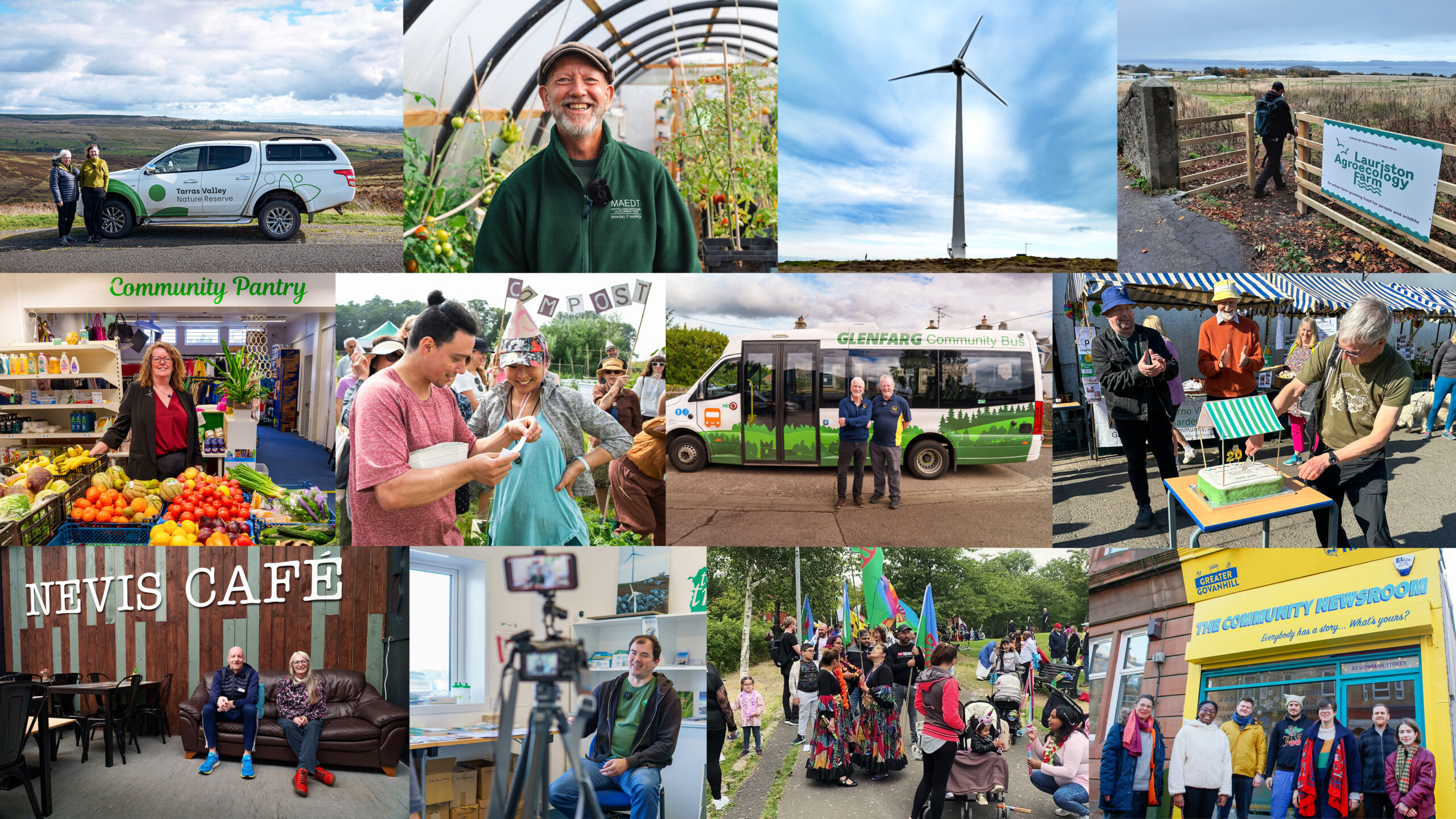
 

Across Scotland, people are quietly transforming their local economies. They’re running bus services, opening community spaces, regenerating town centres and creating jobs. Whether they use the term or not, these communities are practicing Community Wealth Building in real time.

Community-led organisations – the part of the third sector owned and led by local people – are established leaders of Community Wealth Building (CWB). Their work already shapes fairer, more resilient local places at a time when many communities feel increasingly fragile.

You see this in communities across the country: from Glenfarg to Govanhill, Tiree to Tarras Valley. We have been visiting community organisations whose work on the ground is strengthened by national networks such as Community Land Scotland, the Community Transport Association, the Community Woodlands Association, Scottish Rural Action, Scottish Beacon and Get Growing Scotland.

The Scottish Government’s 2025 consultation paper on Building Community Wealth in Scotland describes CWB as ‘growing the influence communities have on the economy and ensuring communities receive more of the benefits from the wealth they help to generate.’ For this to be realised, CWB needs to become a consistent priority across government. If Scotland is serious about moving to a wellbeing economy, CWB principles must be built into economic development, planning, health, transport and climate policy.

The Community Wealth Building Bill completing Stage 1 presents a vital opportunity – but legislation alone won’t deliver change. The real test is whether it helps devolve decision-making and investment so local economies work for local people.

Empowering councils and public bodies is welcome, but it must go hand in hand with empowering communities themselves. Public bodies should act as supportive partners, enabling communities to generate and retain local wealth for both their own benefit and wider society. That means recognising community anchor organisations as credible, equal partners in shaping how CWB is delivered. It means investing in community capacity so people can fully engage with practical processes like procurement, service delivery and the transfer of public assets into community hands.

Across Scotland, community organisations are proving what is possible when local people have the tools and trust to act. Glenfarg rebuilt its bus service after commercial operators withdrew. Tiree has reinvested community-owned energy income into essential services, homes and local businesses. Community land stewardship at Tarras Valley is delivering environmental, economic and social benefits. In Fort William, the Nevis Centre keeps vital community space in local hands. Greater Govanhill’s community-led journalism strengthens local decision-making. And in Mayfield and Easthouses, community-led growing projects are building food security, skills and resilience.

These examples are not isolated success stories. They are part of a coordinated ecosystem of national networks and intermediaries representing Scotland’s diverse community sector. Their collective strength lies in deep local knowledge, shared learning and the ability to scale practical solutions – a ready-made infrastructure that could deliver Community Wealth Building equitably and effectively, if properly recognised and resourced.

The Scottish Community Alliance’s This is Community Wealth Building series, delivered in partnership with Greater Community Media, shines a light on exactly this kind of work. Each story shows a community-led organisation responding to local needs in practical, grounded ways – because they are led by the people who live there. From community-owned transport and renewable energy to local journalism, regeneration projects and village halls, these initiatives show what CWB looks like when rooted in local ownership. They are the community anchors providing communities with a fixed point to navigate from when it is most needed. 

The Scottish Community Alliance is a coalition of national networks and intermediaries who all represent a different aspect of Scotland’s vibrant community sector. What brings us together is a commitment to the community led organisations who shape our sector. Together, we influence local and national policy development to help us create more equitable ways for community organisations to be at the forefront of decision making. That’s why we wanted to platform the impact community-led organisations are making through this project.

Real progress towards Community Wealth Building depends on supporting the community-led action already happening in our towns, villages and neighbourhoods. Each story offers a snapshot of Community Wealth Building being built from the ground up across Scotland. Communities understand that wealth is more than money – it is wellbeing, fairness, resilience and opportunity.

As Scotland moves toward embedding Community Wealth Building in law, we should remember that communities have been leading this agenda for years. The role of government now is not to reinvent it, but to invest in it – to create the conditions where local people can continue building the fairer, more inclusive economy we all want.


Today we have launched This is Community Wealth Buildinga series of stories showing what Community Wealth Building looks like in action across Scotland. The series will be published over the next five weeks. You can read more about the series here and follow us on LinkedIn to stay updated.

News

Tiree: Powering Community Wealth Building with renewable energy

November 17, 2025

On Tiree, a community-owned wind turbine has powered a decade of local investment, funding essential infrastructure and services. As Scotland debates how to embed Community Wealth Building in law, the island offers a glimpse of what that future could look like.

By Lucas Batt & Rhiannon Davies, Greater Community Media


Approaching the wind-buffeted island of Tiree after a four-hour ferry journey, visitors and residents alike are greeted by the sight of Tilley – the community-owned wind turbine that rises fifty metres above the Atlantic. More than a landmark, Tilley has become a symbol of what happens when a community takes its future into its own hands.

“We are very lucky,” says Phyl Meyer, Chief Officer of Tiree Community Development Trust (Urras Thiriodh). “We’ve got a wind turbine right now that is providing the vast majority of funding, which allows my staff and I to be here to do all of these things and to professionally run projects and services.” 

Like many rural and island communities, Tiree’s population has been declining for many years, as people move to the mainland to look for jobs, housing and other opportunities they couldn’t find on the island. Local people became increasingly worried about the sustainability of the school, and the risk of a tipping point for further population decline. 

“There are families who are considering leaving the island because of the lack of childcare,” says Meyer. “And if we lose those families, it’s the impact of their jobs not being filled anymore, and how we replace them, less kids in the school, potential threats to the funding for that, etc. It’s all interconnected and if one domino falls over, another domino falls and another. We spend a lot of our time worrying about how we head off the cascading dominoes.”

In 2006 a group of local people came together to take the future of the island into their own hands, based on the belief that the community needed to generate its own income to be able to make the investments needed in the community, and set up Tiree Community Development Trust.

Their ambitious plan to harness the powerful natural resource flying over their heads paid off. Managed through the trading arm Tiree Renewable Energy Ltd, Tilley – a 900 kW turbine – has channelled about £4 million back into the community of just 650 people, funding everything from critical infrastructure to essential community services.

When the island’s two main harbours were crumbling, threatening the viability of the local fishing fleet, the Trust led a major regeneration, securing the livelihoods of dozens of families. When the island’s only petrol station faced closure, they built a replacement, sparing residents a two-day trip to the mainland for fuel. They run a community broadband service – recently the only working connection after a major storm – and rescued the village shop, which is now also a post office.

To further nurture local enterprise, they constructed four modern business units, providing permanent space for a hairdresser, art gallery and creative social enterprise, allowing small businesses to thrive where they once struggled for space. Now, with housing being the most urgent need on the island the Trust is driving forward a major project to build affordable community-owned homes. 

Their work goes beyond physical infrastructure. The income from Tilley also funds a full-time youth officer who runs a year-round programme of activities, to make Tiree a vibrant place for children to grow up, a Ranger Service to manage tourism, a home energy efficiency improvement and community advice service, a vital electric community minibus and provides small grants for local groups.

At their core, the Trust is responsive to community needs, building solutions and resilience against the threat of domino effects, where one missing service can collapse the viability of industries, ways of life, and ultimately the community itself. Currently the Trust is working to find a solution to the retirement of the last vet on the island, exploring a community-owned practice to ensure the crofting economy remains viable, and working to develop a solution to the lack of childcare on the island.

Rhoda Meek, Head of Communications and Gaelic, says: “The work that community development trusts do is absolutely vital in places like this. You could argue these are things that should be done from a statutory level, but we are where we are. Our development trusts are vital for healthy communities and to keep economic development going.”

“We’re not just about one project,” she adds. “You’re running a petrol station, a business centre, broadband, youth work and a heritage centre, and you’ve only got a population of 650. It’s a lot.

“Core funding is what’s missing. You can get capital to build something shiny, but you can’t get money to keep it running or pay people properly.”

Networks Behind the Success

But this success of community ownership doesn’t happen in a vacuum. It requires an equally expert support system. Enter Community Land Scotland (CLS), an intermediary body providing the critical support organisations like the Tiree Trust need. 

More than 500 communities across Scotland have taken ownership of buildings and land, covering over 200,000 hectares.  As the representative body for Scotland’s community landowners CLS underpins that movement by providing specialist advice, peer learning and national advocacy.

“Our strength in Scotland is that breadth and the way organisations work together,” says Linsay Chalmers, Director of Communities & Operations at CLS. “We support emerging and existing community landowners with networking and peer-to-peer learning opportunities.”

When Tiree began tackling its housing crisis – nearly half of homes are empty or used seasonally – CLS helped by arranging visits to Eigg and Knoydart so the Trust could learn directly from peers who had already delivered affordable homes. That exchange of experience saved time, risk and money.

CLS also supported Tiree’s Gaelic work, providing funding for a development project and convening community groups on Raasay to share learning. Rhoda Meek who works on developing Gaelic on the island says: “Gaelic is hugely linked to crofting and to the sea. For those of us whose roots are in Tiree, our grandfathers fished and worked the ground. Crofting and fishing are still a huge part of our local economy – vitally important and completely intertwined with our Gaelic language and culture.”

Other networks and organisations – Development Trusts Association Scotland, Highlands and Islands Enterprise, and the Community and Renewable Energy Scheme (CARES) – have also provided invaluable technical and financial support, such as funding their new solar array and upgrading insulation in community buildings.

For the leaders doing this challenging work, the connections forged by these intermediary bodies and the support they provide are a lifeline.

Community Wealth Building in Action

Tilley remains Tiree’s financial backbone, but after major repairs it is uninsurable and nearing the end of its life. As Meyer says: “If that turbine breaks tomorrow, we are not insured for loss of business. There will be a cliff edge that we will fall off without more core funding from the government.”

In response, the Trust is investing in more resilient and scalable solar arrays and exploring a local energy co-op to keep profits circulating locally. The strategy is clear: resilience through community ownership.

The work done by the Tiree Community Development Trust shows what Community Wealth Building looks like in practice. Wealth created locally stays local. Contractors are hired on the island, surpluses fund new services and decisions are made by residents.

It reflects a wider shift – now enshrined in the Community Wealth Building Bill going through Holyrood – to root economic power closer to communities. The Bill would require public bodies to develop local action plans that help generate, circulate and retain wealth within their areas.

For Community Land Scotland and its members, Chalmers says Community Wealth Building “resonates with a lot of communities because it really describes what they’re doing naturally. A lot of our members’ models are about creating wealth and reinvesting that back in their communities.”

Josh Doble, Director of Policy & Advocacy at Community Land Scotland highlights that some members have concerns that the Bill won’t do what it needs to. He says there’s been some discussion about a lack of clarity about what ‘wealth’ means and too much focus on state-led approaches: “There’s a fear that Community Wealth Building becomes too fixated on economics, and doesn’t capture the holistic benefits it can deliver for local communities. There’s a danger of it just becoming government jargon rather than a genuinely transformative way of rewiring the economy. That’s why we want to show that communities are already doing community wealth building, so successful community-led approaches don’t get lost.”

Jill Keegan, Partnerships Manager at Scottish Community Alliance, agrees: “Communities have been doing this for decades. The Bill is an opportunity for government and other stakeholders to make what’s already happening easier and more sustainable.”

Tiree’s story shows that Community Wealth Building isn’t a theory – it’s already happening. It’s being built from the ground up by local people, delivering real results, and filling the gaps where both market and state have struggled to keep rural places alive. What the island needs now is meaningful long term support to enable them to continue meeting the local community’s needs, ensuring life on Tiree remains viable and resilient for future generations.


Read more from our series This is Community Wealth Building and what we’re calling for to support Community Wealth Building across Scotland.