Briefings

OSCR intervention

January 19, 2021

In recent months, there have been concerns that Scotland’s Housing Regulator has been too quick off the mark to intervene in the affairs of housing associations - particularly for some reason, the smaller, community led providers. It would be wrong however to assume that the housing sector is alone in having a regulator prepared to intervene directly in the affairs of those it regulates. OSCR, the regulator of Scotland’s 24,000+ charities, has historically enjoyed a light touch relationship with its sector. The recent appointment of a permanent ‘judicial factor’ to run a Wick charity seems out of character. 


Author: Stephen Delahunty, Third Sector

The Scottish regulator has appointed a manager to take over a charity as part of a decade-long inquiry to ensure its trustees do not part with its property without consent.

The Office of the Scottish Charity Regulator opened an inquiry into Wick Academy Development Fund in September 2010 after concerns were raised about its public benefit, and a failure to make use of its accumulated funds.

Formed in 2002, the charity’s purpose is to “provide facilities, or assist in the provision of facilities, in the interests of social welfare for recreation and other leisure-time occupation so that their conditions of life may be improved”.

Up until April 2009, the charity raised £140,000 by selling lottery tickets in the Wick community. However, none of the money was ever spent, according to the OSCR.

Over the next decade the regulator said it had engaged repeatedly with the charity to try to ensure that its funds were used to further its charitable purposes.

But apart from unsuccessful discussions with the local authority about support for Wick High School, the regulator said the charity had not undertaken activities in furtherance of its charitable purposes in the period since it suspended fundraising.

The OSCR said it was necessary to act in order to protect the property of the charity.

Its report says: “The charity is not providing public benefit and is therefore at risk of removal from the Scottish charity register.

“Should the charity be removed from the register the charity trustees would remain under an obligation to apply the charity’s assets in accordance with its purposes.

“We have no confidence that the charity trustees would comply with this requirement.”

In October last year the charity’s trustees were told they could not part with its property without the consent of the regulator.

Trustees then sought to dissolve the charity and transfer its property to other charities, but this was refused.

Further attempts by the OSCR to engage with the charity trustees to address the issues were unsuccessful, the regulator said.

It said that as a result, Eileen Blackburn, a chartered accountant at the accountancy firm French Duncan, had been appointed as a permanent “judicial factor” to manage the charity’s affairs and ensure its property was used for public benefit and in furtherance of its charitable purposes.


Briefings

Placing trust in our young people

Rural communities, particularly the most remote ones, face the perennial threat of depopulation and it is the young, mainly for reasons of employment and a lack of affordable housing, who feel most acutely the need to leave.  But given half a chance, many would stay which perhaps explains why so many young people are taking the lead in developing projects which might just make that possible. On Raasay, the challenge of leading the development of two hydro schemes and a major community share offer has been handed to the island’s youth team.


Author: Community Shares Scotland

Raasay Community Renewables, notable for its young management committee, has a target of £650,000, with aims to install two turbines with a combined output of 127kW. Their share offer also aims to pay 4% interest to shareholders.

Situated between the Applecross peninsula and the Isle of Skye in the Inner Hebrides, the Isle of Raasay (Eilean Ratharsair in Gaelic) is home to 170 people and a rich variety of wildlife and plants. Its name means ‘Isle of the Roe Deer’.

In September 2020, the community set up Raasay Community Renewables Ltd (RCR), a Community Benefit Society (FCA registration number 8459) to develop sustainable energy infrastructure projects that will contribute to supporting the local population and environment.

They invite you to buy shares in their community owned hydro-electric generation schemes which harnesses the combined potential of two run of river hydros – the 99KW Inverarish Burn Hydro and the 38KW Mine Burn Hydro. This is a fantastic opportunity to invest in social and environmental causes and see a financial return for your support in the years to come.

For more information and a short video on Raasay Community Renewables

…..and just across the water, on the Isle of Skye there’s another hydro scheme that is seeking investors. Sleat Hydro, has raised £60,000 towards a target of £235,000. Their share offer, which closes at the end of January, aims to offer investors 4% interest for their support of the 34kW installation. For more information visit their website.

,

Briefings

1000 better stories

The stories we are told as children help to shape how we see ourselves and the world we grow up in. Some of these stories may be in books but others will be the stories we listen to, which describe how others experience the world around them.  And gradually we synthesise all these narratives until we have our own stories that we tell about ourselves. Stories and storytelling play such an important but often understated part in shaping our culture. An important project from SCCAN aims to help our sector tell its many stories. 


Author: Paul Bristow, SCCAN

A message from Paul Bristow SCCAN’s Story Weaver

1000 Better Stories

 “Something I’ve heard quite a few times since becoming SCCAN’s Story Weaver, is that people and projects can sometimes feel a little as if they are just plugging away, doing their best, hoping it makes a difference. And of course, it is making a difference – and viewed as part of a collective effort, there’s been so much distance travelled. Certainly, there is much more to be done, urgently – but we also need more people to understand that change is possible, to inspire new volunteers and projects. That’s the starting point for our new podcast series, 1000 Better Stories.

Over the coming months, we’ll be hearing from all sorts of groups and organisations, from folks involved in community land purchases through to rewilding programmes and outdoor learning. We want to give time and space to as many people as possible to showcase the cultural shifts that are already happening and to help build the momentum for more positive change. And we want to hear from you too.

In August, I ran an introductory story event, which suggested that we all have a responsibility to become storytellers, sharing what we have done with as many other people as possible, not just keeping it to ourselves. So I’m hoping to hear from many more people across the network who want to share their story of community led climate action. If you’re not sure how best to tell that story, then come along to one of our training events, or look out for the sessions we will be running later in the year. 

In the meantime, please enjoy this first episode of the podcast, which features Belville Community Garden and RIG Arts, both from my home town of Greenock in Inverclyde.” 

Please share your stories from your community! Please contact Stories@scottishcommunitiescan.org.uk


Briefings

Registration opens 

The resounding message to come from the Democracy Matters conversations (remember them?) that involved approximately 4000 citizens, was that there continues to be a real appetite amongst communities to have more control over local affairs. Scottish Government and COSLA have both made commitments to respond accordingly. When, where and how that happens remains to be seen. In the meantime, other means exist that communities can utilise to give voice to their concerns. One of which, particularly for rural and island communities, is the biennial Scottish Rural Parliament which convenes in March. Registration has just opened.


Author: Scottish Rural Parliament

We all have a personal story to tell about the events of 2020, including the COVID-19 pandemic and the UK’s uncertain progression towards Brexit.

Wherever you are, as you are, we invite you to bring your story to the 2021 Virtual Scottish Rural Parliament and shape the future of rural and island Scotland. Over five days in March 2021, we will look at some of the things that deeply affect our lives, from local democracy to digital communications and climate change. We will explore what needs to be done so that our communities are thriving, and our natural environment is safeguarded.

Our voice and vision will form the basis of an updated Manifesto for Rural and Island Scotland.  This event is FREE and online. Everyone is welcome. If your family members, pets or livestock choose to join you on-screen, it will add to the richness of the experience for all of us!

REGISTER HERE FOR THE vSRP2021

About the Scottish Rural Parliament

A member of the European-wide network of Rural Parliaments, the Scottish Rural Parliament takes place every two years, each time hosted by a different rural community – Oban in 2014, Brechin in 2016 and Stranraer in 2018. Secretariat and coordination is provided by Scottish Rural Action with the programme and event shaped by a wide range of rural and island organisations. In 2021, the Scottish Rural Action is partnering with the Scottish Islands Federation and Scottish Rural Network in the Secretariat role.

Responding to the pandemic reality, the 2021 Virtual SRP (2021vSRP) will take place online on a platform which is easy to access if you have a mobile phone, tablet or laptop and an internet connection.

Unlike traditional conferences, the 2021vSRP is a grassroots democratic assembly, bringing together people who live and work in rural and island Scotland with decision makers and influencers.  Priorities for rural development are identified and captured in a Manifesto for Rural and Island Scotland. The process of listening to each other, learning from each other and visioning our future together keeps us alive to the power of collective activism and action.

The 2021vSRP Programme

The 2021vSRP will take place online over five days in March 2021.  Each day includes interactive sessions on different topics, enabling participants to explore current thinking and to identify actions that will make a positive difference to our future lives and livelihoods. The closing session on day 5 invites a panel of decision makers to reflect and respond to the recommendations emerging from the 2021vSRP explorations.

2021vSRP sessions use a mix of presentations and interactive elements, including breakout rooms, café style conversations, polls and collaborative whiteboard space, to ensure participants have multiple options to listen and contribute in their own time and at their own pace.

A networking facility, connecting you to other participants, and a virtual exhibition space, showcasing organisations, causes and culture will be available throughout.


Briefings

Why food banks must end

The ubiquity of the food bank in our communities and the teams of local volunteers on hand to distribute food parcels has been praised and condemned in equal measure. Praised because it is an indicator of the kindness and compassion that the pandemic has revealed across the country. Condemned because of the disgrace that the fifth largest economy in the world tolerates a  level of poverty that prevents every citizen being confident that their human right to food will be met with dignity. Pete Ritchie of Nourish Scotland is unequivocal - the food bank era must end.


Author: Pete Ritchie, Nourish Scotland

One of the first lessons we’ve had to learn in this crisis is that running out of food is not a problem of supply. It’s a problem of distribution. £1 billion worth of food that would otherwise be on the shelves, is in people’s cupboards and fridges.

Meanwhile, foodbanks up and down the country view the lockdown announcement with alarm. Will they get supplies from public donations or be able to buy them from the supermarket?

How will they cope without the (often older) volunteers who are now not allowed to leave their home to work in them? Will they be allowed to stay open?

There’s no doubting the good intentions of the people who run and work in foodbanks. They have been picking up the pieces of ten years of austerity. But now, enough is enough.

It’s completely possible to give people money to buy food themselves if they have run out of cash. In Scotland, it’s called the Scottish Welfare Fund, and it’s just been more than doubled by the Scottish Government. It’s perfectly possible to issue people with a card to use in shops which the government then loads with money. In Scotland it’s called Best Start Foods. It’s perfectly possible in the short term for GPs, schools and welfare agencies to hand out supermarket vouchers if people need them.

We have an amazing food distribution system. Cunningly, shops have been located near where people live, and most of them deliver. They are open much of the time. Let’s put the systems in place to ensure everyone can access the food distribution system on equal footing. It’s a matter of human dignity.

Making foodbanks inessential takes a little money, sure. To cover the cost of the food given out each year by Scotland’s foodbanks would be around £6-7 million – 2% of the £350m investment in tackling poverty announced last week by the Scottish Government.

To raise the incomes of the poorest 10% of the population of the UK by £30 per week and make a real dent on food insecurity would cost £10bn – 3% of the rescue package announced last week by the UK government.

And it needs a little work to imagine a Scotland without foodbanks – but rather less than imagining a national lockdown, a ban on weddings, rail renationalisation, no football, no church, no Olympics.

We’ve discovered that we genuinely are all in this together this time. So let’s not pretend that it is essential for people who have run out of money for food (who may themselves be vulnerable) to go to an agency to collect a voucher to take to another location when there’s little or no public transport to get a parcel of food which they haven’t chosen, often from an older volunteer who themselves should also be staying at home. And remember, the food itself has come from the supermarket where everyone else goes.

Let people stay home, and let’s get them the money they need to get the food they need to sit this one out.

Foodbanks are not essential, and it’s time to close them for good. We are all enlisted now.

Pete Ritchie is director of Nourish Scotland.


Briefings

CCP – update on the update

Just before Christmas, Scottish Government finally published the ‘update’ of its Climate Change Plan. This is important for a host of reasons - not least because it is the most accurate up to date measure of Scottish Government’s ambition to tackle the climate emergency at a time, with COP26 coming to Glasgow, when Scotland will be in the climate spotlight as never before. Stop Climate Chaos Scotland has drilled into the detail of the Plan and highlighted the areas of greatest weakness. There are some real strengths too. 


Author: SCCS

The campaign has two elements, that aim to show public support for an ambitious plan:
E-action: This is now live on our website here. We are aiming to get 1000’s of sign ups to an editable letter to Roseanna Cunningham so that we can present the number of responses and personal messages to her in mid February before the plan is finalised. Please share as much as you can and sign up yourself!
If you would like to host the e-action directly on your website this is very easy to do, please just let me know.
Social media: As the four Parliamentary Committees hold evidence sessions throughout January we want to tag them on social media as much as we can. There is a guide to social media posts, newsletter content and the details of the committees remits here. Or please just share our tweets @sccscot.

Climate Change Plan update – overview

  • Recommitment to targets – reaching net zero by 2045 and reducing emissions by 75% by 2030.
  • The plan appears to get close to reaching the 2030 target, but there is uncertainty over the data and how it will be achieved
  • More plans and strategies need to be developed and these will need to be monitored
  • There are some welcome and positive measures, but some areas that lack detail and ambition and are cause for concern
  • Technologies that are currently unproven, such as carbon capture and storage, still feature too heavily in the plan
  • The concept of Just Transition is fully acknowledged but there is no commitment to a plan or updated strategy and it is unclear how it will be delivered Climate Change Plan update – agriculture, land use and marine

Climate Change Plan update – agriculture, land use and marine

  • Lack of ambition in agriculture, with smaller fall in emissions projected compared with other sectors and few firm commitments to action
  • New policy proposal to introduce environmental conditionality in the agriculture sector is potentially welcome but lacks detail, especially in relation to its climate impact
  • No new targets for woodland creation
  • No commitment to end the burning of peatland or ban the use of peat in horticulture
  • Issue of deer management not addressed, despite its carbon saving potential
  • Commitment to further research on marine but no policy proposals to help protect and enhance seas as a crucial carbon store Climate Change Plan update – buildings and electricity

Climate Change Plan update – buildings and electricity

  • The long-term objectives of the “Heat in Buildings Strategy” are very welcome and the measures to deliver are fairly comprehensive, especially the proposals regarding building standards and regulations.
  • Proposal to introduce “regulations for all buildings to achieve a good level of energy efficiency” is welcome
  • No commitment to phase out high carbon heating like oil and LPG in off-gas areas by 2025 or to set a date for the phase-out of replacement gas boilers in existing homes, but much welcome discussion of the need to do so, of alternatives and proposals to provide financial incentives to the alternatives.
  • Proposed investment of £1.6 billion in heat and energy efficiency over the next Parliament is welcome
  • Overall, the policies and proposals for the further development of renewable energy and the decarbonisation of Scotland’s electricity production/distribution are generally welcome Climate Change Plan update – transport

Climate Change Plan update – transport

  • There is no commitment to stop building new trunk roads or motorways.
  • A new target to reduce car kilometres by 20% by 2030 is very welcome, forward thinking and not being done in the rest of the UK. A roadmap of how Government plans to make this happen will be produced in 2021.
  • Only 3% of the transport budget will be for active travel – well short of the 10% we called for.
  • The new £50 million for ‘Active Freeways’ is a potentially welcome initiative. This is said to ‘involve identification and design development of the strategic active travel network, to provide segregated active travel routes on main travel corridors to city and town centres and major trip attractors linking communities throughout Scotland’.
  • No specific mention/policy of achieving zero emission zones in each city
  • No real action on aviation, we called for the introduction of a Frequent Flyer Levy Climate Change Plan update – waste

Climate Change Plan update – waste

  • Commitment to look at how to make incinerators less damaging, rather than banning new ones
  • Investment to deliver recycling targets falls short of what is needed and compares poorly to investment in Wales
  • No commitment to which single use plastics could be banned or promotion of alternatives
  • No commitment to building a circular economy

Briefings

Zoom bias

It seems likely that one of the lasting legacies of Covid will be the transformation of some of our workplace practices. For all its obvious limitations, Zoom, along with all the other variants of online communication, has made meeting with colleagues so much more accessible than before. But if Zoom becomes even just a part of the post-Covid normal we’ll need to become more aware of aspects of this medium that are perhaps less obvious at first glance. Interesting research into the inherent gender biases prevalent on Zoom which could easily be applied across the board.


Author: Natalie Marchant

Women are systematically seen as less authoritative, study shows.

Changing the environment in the room – rather than changing women’s behaviour – should be the goal.

Diversity efforts may have given women a seat at the table – or, in the context of the pandemic, a place on the Zoom call – but that doesn’t necessarily mean they have a voice.

With working from home now the norm for many, a growing body of research is showing that it’s not become a leveller for meetings.

Almost half (45%) of US women business leaders surveyed in September said it was difficult for women to speak up in virtual meetings on platforms like Zoom, while one-in-five women felt they’d actually been ignored on such calls.

Researchers at Brigham Young University in the US found last year that the gender dynamics shutting down women remained prevalent, even in the most well-intentioned settings.

“Women are systematically seen as less authoritative,” Jessica Preece, associate professor in political science at BYU, told BYU Magazine.

“And their influence is systematically lower. And they’re speaking less. And when they’re speaking up, they’re not being listened to as much, and they are being interrupted more.”

So what’s going on?

Preece and her colleagues examined the female experience in a male-dominated collegiate accounting programme, in which women were typically enrolled with better grade point averages and more leadership experience than their male counterparts

Students pass through the programme on teams, and administrators wanted to know how to best build these groups.

In teams where women were outnumbered, the researchers discovered they were routinely seen as the least competent and influential in the group.

The problem is not necessarily intentional bias or misogyny. It is instead a systemic problem with society that often sees cultural norms and gendered messages shaping the rules of engagement, explained Preece.

We have been “slowly socialized over years to discount” female expertise and perspectives, she said.

“It’s not women who are broken; it’s society that’s broken,” she added. “I’d like to see us focus on training people to be – and creating systems that are – supportive of women who speak up.”

This means the goal needs to be changing the environment in the room, actual or virtual, rather than women themselves – so that they are empowered and listened to.

“We have lots of learning and unlearning to do.”

Towards gender parity

Gender parity can affect whether or not economies and societies thrive, according to the World Economic Forum’s Global Gender Gap Report 2020 – particularly important as countries seek to build back better after the coronavirus pandemic.

McKinsey Global Institute’s 2015 Power of Parity report estimated that advancing women’s equality could add $13 trillion to global growth by 2025.

The Forum’s report saw improvement in educational attainment, and health and survival, with the gender gap closing by 96.1% and 95.7% respectively.

But more work needs to be done in the area of political empowerment (24.7%) and economic participation and opportunity (58.8%).

Women have been disproportionately impacted during COVID-19, according to McKinsey Global Institute, with greater job losses, often as a result of increasing unpaid care.

BYU researchers say that even small changes to make sure women in a meeting, or on a call, can fully contribute or express their views can make all the difference.

Positive interjections, such as “that’s an interesting point”, can elevate and help validate women’s voices in spaces where they may otherwise be lost, they added.

The goal is to create an environment in which women can be as influential as their authentic selves, says Preece.

“If we build a world in which women’s voices are valued and listened to, they will speak up without having to be told to.”


Briefings

Wikibirthday

It’s hard to imagine that anyone who spends time online doesn’t rely on Wikipedia as the default source of information about anything. Twenty years old last Friday, Wikipedia is remarkable for many reasons not least that in this era of social media behemoths driven by algorithms which seem almost designed to encourage bad behaviour, it has remained open source, not for profit, advertisement free and run by hundreds of thousands of volunteer editors. It is the best of what the pioneers of the world wide web envisioned it might become. Happy birthday, Jimmy Swales and Larry Sanger.


Author: Heather Kelly, Washington Post

Wikipedia is a thing that shouldn’t work, but somehow does. Hundreds of thousands of volunteers, without pay, collectively trying to document every corner of human knowledge, including history happening in real time.

This month, the online encyclopedia‘s strengths and quirks were on full display as hundreds of volunteers furiously worked to create a page for the Capitol riots as events unfolded Jan. 6. As it transitioned from a protest to something more violent, Wikipedia’s volunteer editors added key details while debating the article title, as shared by editor Molly White. Was it a protest, an insurrection or a riot? It ended up the “2021 storming of the United States Capitol.” Hundreds of people were working on the ballooning document at a time, which has now been touched by nearly 1,000 editors, is more than 10,000 words long and has been viewed nearly 2 million times.

Like most Wikipedia articles, it will continue to change, a fluid draft of history meant to stick as closely to dispassionate facts as possible while regularly swatting off attempts to insert opinions and disinformation.

“I think the large number of editors helps to make sure different viewpoints are considered,” said White, who has put in 12 hours of editing on the page and related wikis since last week. “Any changes must be carefully sourced, and there are constant discussions to ensure neutral tone and appropriate weight to topics within the page. … It is the lower-profile pages that are more susceptible.”

Wikipedia is turning 20 years old on Friday, and in the midst of heightened concerns about the spread of disinformation and misinformation, its pages on controversial topics or current events can be a balm. The page for QAnon gets straight to the point in its first line, saying it “is a disproven and discredited far-right conspiracy theory.” The page for the Proud Boys is equally straightforward, calling them “a far-right, neo-fascist, and male-only political organization that promotes and engages in political violence in the United States and Canada.”

Founded in 2001 by Jimmy Wales and Larry Sanger, Wikipedia is an ad-free site edited by volunteers and hosted by the nonprofit Wikimedia Foundation. It’s one of the 20 most popular sites on the Internet, and its pages are regularly the top results for Google searches. Anyone interested in changing an article is allowed, and people with more experience can gain more privileges. Some editors have specialties, others are generalists, and they all donate their time and energy to try to keep the resource clean and informative in multiple languages. Editors follow a few basic tenets, including that posts should have a neutral point of view, they should treat each other with respect and that there are no firm rules.

They’ve had a busy year. Like many other sites, Wikipedia saw an increase in use during the pandemic, especially the early months. In addition to having more time to contribute, editors have also had an unending stream of news topics to work on.

Many conversations happening between Wikipedia’s editors reflect what’s happening inside news publications and tech companies, but are being played out largely in public. You can see a history of revisions for each story and some of the back and forth between people editing it under the Talk pages, which show discussions between editors. It’s a real example of the word tech companies frequently throw around when discussing their controversial moderation decisions: transparency.

What’s most striking about Wikipedia is its sheer size. Like the number of posts (55 million), the number of volunteers (270,000 active editors a month) and even the number of edits that have taken place (it just passed a billion).

“It is remarkable that it exists when you think about the history of knowledge in the world and who has access to it and the very idea that people can participate in it,” said Katherine Maher, CEO of the Wikimedia Foundation. “It is a somewhat radical act to be able to write your own history, and in many places in the world this is not a thing people take for granted.”

Wikipedia still has its share of errors and incorrect information, though it says most “vandalism” is removed within five minutes. There’s a rich history of hidden pranks and hoax entries; partisan protest edits, like the repeated deletion of Donald Trump’s entry; and angry vandalism, like when Beyoncé’s fans attacked Beck’s page when he beat her out for a Grammy. Last year it was discovered that an American teenager had created nearly half of the Scots language Wikipedia pages, without actually knowing the language. Screenshots of these temporarily altered entries can go viral and be seen long after the pages are fixed. Given its size, smaller errors can go undetected for years.

The site has also struggled with diversity among its editors, who skew largely white and male for English-language entries. Wikipedia says that less than 20 percent of its editors identify as women, and a 2018 survey conducted by Wikimedia found 14 percent of editors had experienced some form of harassment.

But it doesn’t face the same kinds of issues with disinformation that the big tech companies do. Everyone from Facebook and Twitter to Snapchat have struggled with moderation, attempting to balance a desire for not wanting to be seen as censoring users with an overwhelming volume of problematic, violent and racist user-generated content. Many social media companies have been hesitant to come out and say some sources are less trustworthy than others for fear of alienating part of their audience. Moderation is largely handled by paid workers who review posts flagged by people or automated systems and follow ever-changing internal rules to determine what stays up.

Facebook has had to hire tens of thousands of moderators and has built custom artificial intelligence systems which now detects more than 94 percent of the hate speech that is removed from the site. It has tried to rank sources by how trustworthy they are and suppress the reach of problematic content. In the past week, it started removing content around the “Stop the Steal” phrase. Ahead of the election, Twitter tried to make it harder for misinformation to spread by removing the ability to retweet without a comment. And most recently, all the big social media sites, from Facebook to Pinterest, banned or suspended President Trump’s accounts after the Capital riots.

While also populated entirely with content from users, Wikipedia has a number of things on its side when it comes to moderation. One of its key advantages is that there is only one page for each subject, and duplicates are removed by editors, meaning it is not set up in a way that lets things go viral. While thousands of misleading articles about the November election results might circulate on Facebook, there is only one main story to tend to on Wikipedia.

It also has a number of tools meant to keep articles clean. There’s the ability to protect and lock down pages, limiting the ability of new editors to change them. People who frequently make false edits can be banned. Editors follow policies meant to keep out anything untrue, such as requiring sources for all claims. And when it comes to those sources, there is of course a Wikipedia that lists sources and rates them according to how reliable they are. Still, the site is open about not wanting to be a reliable source.

“Wikipedia is very open about that fact that we’re not a reliable source. It’s actually a tenet of Wikipedia, which isn’t to say we’re not a good place to start,” Maher said. “We are a great place to start. We just want people to have the ability to read the content on Wikipedia with a critical eye.”

Not everyone sees it the same way. Some of the big tech companies have turned to Wikipedia as a source for fact checks. In 2018, YouTube surprised Wikipedia editors and Wikimedia when it announced the site was going to be a fact-check partner, with text from its articles under controversial videos.

For the past 15 years, Anne Clin has worked as a volunteer editor on Wikipedia under the name Risker. She started by fixing a single typo and has gone on to become an administrator who spends between one and four hours a day editing stories. Her specialty is areas of conflict, like hotly debated topics. She looks out for articles that need to be protected, meaning only experienced editors can make changes, and keeps an eye out for nonpublic information like phone numbers that need to be removed. The site has changed dramatically since she started.

“It’s an evolution. I probably wouldn’t have considered it a reliable source back in 2005. It was getting there, it was just starting off,” said Clin, who recently retired from her job in health care. “But as we have developed over the years and created our infrastructure to support really good quality data, it’s really helped a lot.”

While the more obvious targets for disinformation are locked down, Clin and other editors have learned to keep an eye on unexpected pages. If someone can’t say the QAnon conspiracy theory is true on the topic’s main article, they might find ways to sprinkle its misinformation into lesser-trafficked wikis.

That’s how they discovered the page for Benford’s law, an obscure mathematical theory. Some followers of the QAnon conspiracy theory had seized on the mathematical theory as proof that the November election was fraudulent, and changed the Wikipedia page accordingly. Clin turned to a group of editors who work specifically on mathematical articles and quickly cleaned it up. Stories about QAnon’s conspiracy theory on Benford’s law are still circulating on social media.

Briefings

Community growing – the new cool

December 14, 2020

Whenever a new list of the most-this-or-that place on the planet is published, it’s wise to treat it with a healthy dose of scepticism. These lists are also, irritatingly, a little compulsive. But when a neighbourhood in Glasgow’s East End appears at number eight in TimeOut’s List of the world’s 40 coolest neighbourhoods, all doubts about its veracity disappear out the window. And one factor that has contributed to the emergence of Dennistoun as the place to hang out is Alexandra Park Food Forest - just one more example of Scotland’s ever expanding community food growing movement.


Author: Sean Wai Keung

When Dennistoun, in Glasgow’s East End, appeared at number 8 in TimeOut’s 2020 list of ‘Coolest Neighbourhoods in the World Right Now’, the Alexandra Park Food Forest received a special mention as an example of this cool-ness. Many Voices Many Kitchens had the pleasure of chatting to founder and director Clem Sandison about how the Food Forest has continued to engage their local community, their permaculture principles, and a delicious recipe for french apple pudding!

SWK: Could you describe the Alexandra Park Food Forest for me?

Clem: Alexandra Park itself is a green space in the East End of Glasgow, and we started planting the Food Forest there in 2016, with the idea being to create the most regenerative possible way of producing food while also benefiting biodiversity and wildlife. Which is different from a community garden with raised beds, because it’s in a public park and is therefore fully accessible at all times. Instead it’s more like a community orchard, although we’re also integrating different food plants beyond just fruit trees. It’s all still a work in progress, but the main thing is that it’s all designed using permaculture principles, which includes things like preserving soil quality and protecting biodiversity while also building good community relationships and allowing for equitable distribution of resources between people.

SWK: What does this mean in practical, day-to-day terms?

CIt means that people can come and harvest things for free! Which itself means that there’s also an education process where we look to teach people about the right time to harvest things, as well as what’s available and how it can be used. We’re also developing more perennial beds for edible and medicinal plants, which once again ties back to the education side of things as well. So really, the Food Forest is only partly about food production, with the rest of it being about creating and maintaining a biodiverse green space while also building up local community knowledge and spirit.

SWK: What made you want to do something a bit different from a community garden?

C: I’m really interested in how public parks can be used for more productive growing purposes, but the thing about community gardens and allotments is that it’s harder to do them in a completely publicly accessible space. We didn’t want to have as many structures as a traditional community garden, instead we wanted it to be as naturalised to the local environment as possible and to require very little maintenance. So that means that instead of raised beds, for example, we just try to integrate edible plants, trees and bushes into the pre-existing landscape.

SWK: Could you tell me more about that pre-existing landscape?

C: It’s a big open grassy area, about an acre in size and surrounded by mature trees – which makes it a real sun trap! People walk through it at all times of the day, kids play there, and there are always loads of things going on, so we wanted to keep that full accessibility in place. It also means that planting new trees for the Food Forest just suits the site in a very natural way.

I do think that it would be really nice to see more community orchard style planting in other parks, because it doesn’t infringe on public access, whereas with things like community gardens and allotments you need to consider fences and boundaries a bit more. Which is important as well, of course, but it’s just not what we were looking for. At Alexandra Park we had wildflower meadows and trees here already, so our job was just to integrate plants around that.

SWK: How did you go about designing the Food Forest and how have you found the educational side of community engagement?

C: Before we planted anything we did a four-day design course, which involved twelve people from the community over four weekends and included things like a visit to another food forest and permaculture demonstration site, as well as different observational activities around Alexandra Park as well. All of that really helped to make the project feel really collaborative, while also giving us practical advice on how to actually use permaculture as a framework. We worked with Lusi Alderslowe on that, who’s an amazing permaculture teacher.

Since then, we’ve tried to organise our own activities to encourage people to think about food and parks in a different way as well. For instance, we try not to have any bare soil at any point, so we do a lot of things like mulching to keep the soil healthy, which is a bit different from how a lot of people see gardening. So in order to do that we first had to set up volunteer days to teach people about no-dig, low-input soil-care methods. We’re at the stage now where most of our board members have knowledge of permaculture, so we do just put ourselves in that position to organise volunteers, so in that sense what we’re doing isn’t really formal training, it’s more just sharing events with people and being open about what we’re doing and why we’re doing it.

SWK: Would you say that there’s a heritage aspect to the Food Forest as well?

C: In a way, definitely. We have a variety of heritage apples and pears and we’re always very careful to source them from Scottish nurseries – particularly Andrew Lear in Perthshire, who’s done loads of work on heritage fruits and reviving historical apples.

In terms of the actual park itself, it’s interesting because it’s never been built on. So it’s always been a park, and before then it would’ve just been part of the countryside. We’ve looked at maps from the 1800’s that show sheepfolds on the site so it looks like it’s likely to have been farmland at some point too. Because of that, it’s quite unique in Glasgow, as a lot of the land used for communal growing here often has to be raised up above the ground because the soil has been contaminated from industrial use. We’re lucky we don’t have to do that, so our job is more just to preserve and rebuild the soil that’s taken a hammering from being mowed for decades and hasn’t had much put back into it in terms of nutrients. Before we began the Food Forest the park was really just a short grass monoculture with very little plant diversity.

SWK: How did you go about changing that monoculture?

C: We got wood-chip mulch from local tree surgeons for free, which is nice. So whenever they brought a load to us we just topped up all the trees in order to build up a thick layer of compost which then fed the soil organisms and improved the water filtration. This then created a much healthier environment for all the trees, where the soil resembled natural woodland rather than the compacted, clay-like, depleted soil that had been there for years previous.

SWK: How has COVID and lockdown affected the Food Forest?

C: On the negative side it means we haven’t been able to do any of the activities or events we would normally do. But then on the positive side, from what I’ve seen, the whole park has been used a lot more, which is great! I think especially during Summer there was just a higher amount of people looking to make use of green spaces across the city, so we would get things like people doing yoga and kids playing in the willow dome and it was all just visibly a lot busier!

We also had a lot more requests from people to volunteer, once again probably because so many people are stuck at home and looking to reconnect with nature and their local community in some way. Which was frustrating because at the height of it all we weren’t able to do much volunteering anyway! But it’s also good because it shows that we’ve managed to continue to engage with the community through the year.

SWK: It must help that you’re in such a publicly accessible space as well?!

C: Definitely! We have open areas for picnics and instead of benches we have mobile wooden logs, and what we found was that while we normally place them all in one specific area, during the first lockdown people started to organically move them to different spots without any intervention at all! So you could really see all these small groupings of logs in different areas, all spaced out to adhere to social distancing!

Small things like that made me happy, because it was due to how we designed the space and our decision to make use of those wooden logs that meant people were able to safely get together in groups.

SWK: On the food side of things, do you specifically produce anything for yourself? Or is it more just offering out the raw food to the local community so that they can use it however they wish?

C: To be honest, the trees aren’t old enough yet to have a huge amount of surplus. And we’re also finding that people tend to harvest things a bit too early, which is an ongoing dilemma for us. On the one hand it’s understandable, as people will see an apple that looks ripe so they’ll pick it without knowing that it’s still quite sour and not ready yet! So we try to put signs on the trees advising on the best picking times, which works for a while. But people are just really excited to be able to have apples for free, so even then they tend to get picked early. None of this will be a problem when the trees get a bit older, but for now it means that we just don’t have enough to make our own products. We will get to that stage eventually, and because we have seventy-four trees, by the time they’ve all matured we’ll end up with so much surplus that we can hopefully do loads of other things with them. We will definitely always let people pick their own to do whatever they want with, but I’m excited to be able to use the leftovers to make juice or chutneys, or even just to donate to local schools!

SWK: Outside of lockdown, how has overall community engagement been, especially during the early days of the project?

C: Well whenever we’ve had an event or workshop organised we’ve always had great attendance and engagement, but where it has been more difficult is getting people to take on the organisational and admin roles. People really want to do the physical work and mulch and prune, so stuff like that we have no problems filling in, but getting someone to take up a longer-term, behind-the-scenes position, where they would actually facilitate the events and deal with things like health-and-safety and fundraising, is a bit more difficult. I think that’s common with a lot of community projects, where people really want to do the fun bits, but then who’s going to do all the voluntary admin stuff!?

SWK: How do you see the future for the Food Forest?

C: We’re at a crucial point at the moment where we have to decide if we keep the project small, light-touch and volunteer-led, or if we try to get some kind of longer term funding in place to get paid staff who can take over some of the admin duties and really upscale what we’re doing. Because it will take a while for the fruit trees to mature and there’s so much stuff we could be doing in the park in the meantime!

We also have the Alexandra Park Golf Course really close to us, which has now closed, and is its own massive site where I think there could be real potential if we gained access to some of that space as well. I’d love to have areas set aside for a fenced community garden or to use for potential livestock, which would be so useful for us! If we could get some hens then we’d just have so many more nutrients going back into the soil! I’d love it if we could integrate animals more!

SWK: Any other animals beside the hens you would like?!

C: Goats! It seems crazy to me that with the ethos we have about low-input, low-carbon footprint, food production, we still have to have the Council come and mow our grass in certain areas! We do have long grass for the meadows, but there’s still other parts which are currently using a lot of fuel to maintain and so I would love to be able to see more grazing going on, and goats would be perfect for that.

SWK: Lastly, it must have been amazing to see the Food Forest grow over the years – how do you feel, looking back?

C: Yeah! When I first started, I took loads of observation photos of the park, just to try and figure out the best spaces for fruit trees, so I have all this documentation of how it used to look before we planted anything, and it really has been such a transformation! It can be hard at times not to be a bit impatient with fruit trees because you do want them to be super-abundant straight away and of course that’s not how it works, but when I step back and think about what we’ve done I’m so happy with it.

 

Briefings

Swim for your money

The Isle of Kerrera, just off Oban, has 68 residents but lacks the basic amenities for them to meet and socialise and to be able to make any kind of tourist offering for the annual 15,000 visitors. Last year the islanders purchased the near derelict Old School House but needed more cash to complete the renovations. A crowd funder was launched and as a mark of how committed the islanders are, two young lads whose mums both attended the school took the plunge to make an epic fundraising swim across the Sound of Kerrera. Lovely wee film too. .


Author: Isle of Kerrera Development Trust

While there’s an abundance of stunning scenery, the Isle of Kerrera boasts little in the way of facilities for the 68 strong community or the 15,000 annual visitors.  We want to change that and create a new and much needed community hub, right in the centre of the island. You can help us- and get yourself some incredible rewards! These are perfect for a unique and thoughtful Christmas gift for your friends or family!

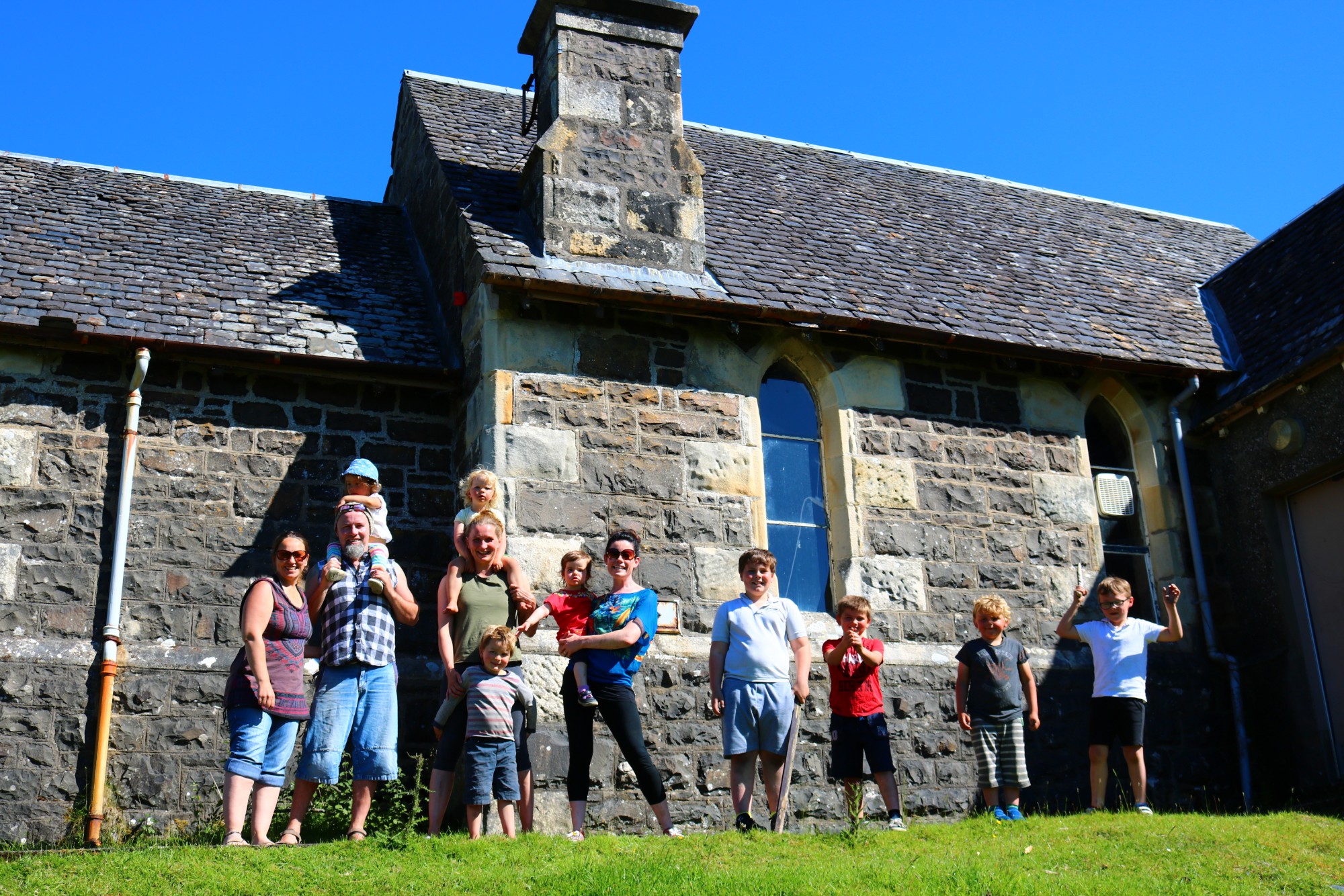
Following years of efforts and dedicated energy from the volunteer board of the Isle of Kerrera Development Trust- the islanders are delighted to finally own their first ever community building. The IKDT purchased the old primary school building in July 2019, thanks to the Scottish Land Fund. Now we need to raise around £25,000 by community fundraising for the renovations- in particular for new windows and doors and to fix the walls- and that’s where we need your help!

1605089987_kerrera_islanders_standing_outside_old_school_-_edited.jpg

A new Community Hub in the Old School

This new facility will mean that our thousands of annual visitors will be able to use the flushing toilets, access drinking water, buy island produce, learn about island life and even stay overnight in unique accommodation. There is no school, doctor, library, post office, shop or pub on Kerrera- islanders need to travel to the mainland for all services. With the last scheduled public ferry at 6pm, opportunities to take part in any sports, cultural or social activities are very limited. We plan to change all that and renovate the old school to create a simple, fit-for-purpose community centre, right in the heart of the island.

With it’s first ever community building, islanders will have a place to meet, to learn, socialise and develop lasting relationships and memories. The 19 island children can attend playgroups, classes and after school activities. Islanders can keep fit, learn to dance, discuss their favourite books and have meetings to continue and develop island projects. Birthdays, weddings, Halloween and Christmas parties will all have a home.  The benefits of the new centre are undeniable and will be genuinely life-changing.

Fantastic Selection of Exclusive Island Rewards!

We’ve compiled an amazing selection of rewards for you- ranging from simple acknowledgement on our donor wall or a tin of wonderful Sea Tea and an island tote bag, to a unique chance to experience the island like a farmer, feeding the friendly cows or cute pet lambs. There’s a chance for a weekend stay with dinner- or even a full blown private island event (all following covid guidance of course) in our wonderful new island marquee- perhaps this is the location for your dream wedding!

Please help us to give our much loved old island building a new lease of life! Help our island community reduce the impact of social isolation and finally have a shared space to meet, socialise, learn and thrive! Help us to make the island a more visitor-friendly destination, and please be sure to come to visit us and tell all your friends!

All rewards will be arranged in line with current government guidance regarding coronavirus at the time of booking. Activities and tours are suitable for families (max 5 people from one household), except for the “Cuddle the Cows”- this is limited to the size of the quad trailer (maximum two adults and one child). Should any activity need to be rearranged, we will do our best to provide a suitable alternative.

For the private hire of the island marquee, please note that the marquee can be available up to 7pm (last available ferry) unless otherwise arranged. Hire includes tables and chairs for up to 30 people, electricity supply and access to toilet facilities. Please get in touch to discuss your idea!

For further information about any of these rewards or activities, please contact: aideen@isleofkerrera.org