
From market days to hydropower: Community Wealth Building in Balerno
December 4, 2025
On the edge of Edinburgh, a village trust is using a farmers’ market, a hydro scheme and a former police station to stop their community becoming a sleeping suburb.
By Paul Fisher Cockburn
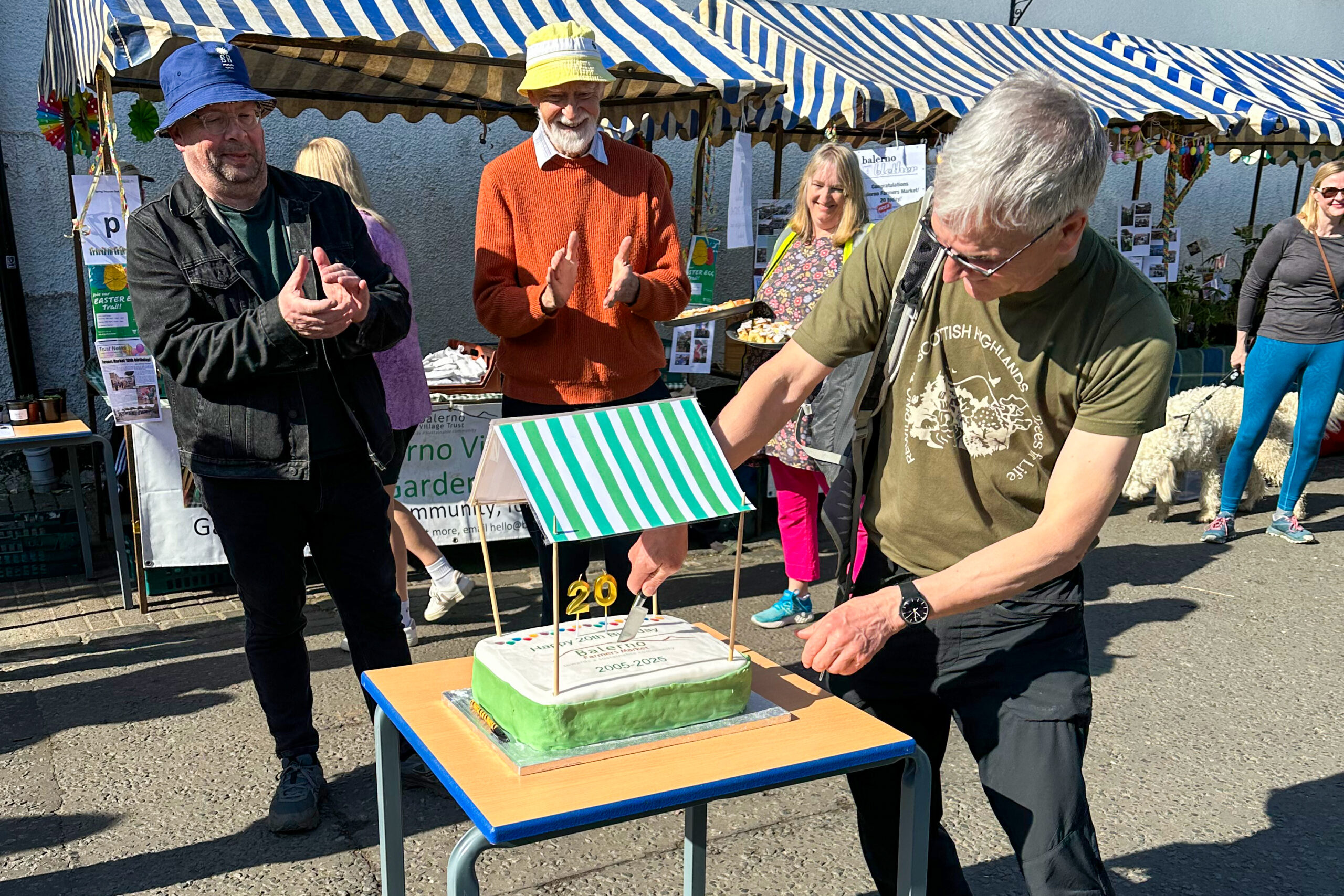
On the second Saturday of April 2025, the main street of Balerno was unrecognisable. Where cars usually rush through to the Pentland Hills, stalls crowded the road. The sun shone, and over the course of four hours, more than a thousand people flooded the street, buying fresh produce, meeting friends, and reclaiming the centre of their village.
It was the 20th anniversary of the Balerno Farmers’ Market. For the Balerno Village Trust (BVT), which runs the market, it was a celebration of two decades of Community Wealth Building. “The whole idea was to revitalise the Main Street,” says Emma Galloway, Chair of BVT. “To me it’s probably the biggest example of community wealth building,” she says.
Balerno sits on the south-western edge of Edinburgh. As a community, it risks becoming a dormitory village – a place where people sleep, but don’t really live.
“The challenge we’ve always had is that, if we’re not careful, Balerno could easily slip into the kind of place where people leave it in the morning, go in to the city to work, come back seven o’clock at night, go into their houses, shut the door, and that’s that. A suburb.” says Emma. “What we want is a thriving community where we know each other.”
The economics of Main Street
The Trust’s strategy to prevent this is simple: make Balerno an even better place to live, work and visit.
The market acts as an economic anchor. On market days, footfall spills over. The local chemist is busy; the hardware store is busy. Money that might have leaked out to supermarkets or city centre chains stays in Balerno, circulating among local suppliers and businesses.
“The whole theory of community wealth building is, if you can support small local businesses then actually the community benefits,” says Emma. “If you spend your money in a big supermarket, the profit goes to shareholders. If you spend it with a local supplier, the profit stays.”
They run special events to provide more reasons for people to come to Balerno and shop locally, with an annual Apple Day (celebrating “everything apple”) and Tattie Day (“about selling seed potatoes”).
The Market is also a well-established meeting place for local groups and organisations, ranging from local community council members to the district schools’ pipe band. “We have a number of organisations that will jump onto the market to raise their profile or to raise funds.”
“Community can talk with community,” says Emma. “If you want to know what’s going on in the community, come to the Market and you’ll get a sense of it.”
From events to assets
The Market may be a regular event on the second Saturday most months of the year but it’s also a temporary one, set up and taken down on the day. Since the Pandemic, however, BVT has become not just a property manager but also a property owner.
In 2021, when the Balerno Community Centre faced an uncertain future, the Trust stepped in, recognising its importance as a community asset and meeting space. The City of Edinburgh Council offered them a decade-long lease for £10, on the condition that BVT upgraded the building.
They didn’t just paint the walls. They installed solar panels and air-sourced heating, transforming an aging liability into an environmentally friendly asset that now hosts a post office on Wednesdays.
But their most ambitious move was the purchase of the former Balerno Police Station, supported by the Scottish Land Fund. “When that went up for sale, we thought this was a real opportunity to try and find out what the village needs,” Emma recalls. “The village came back and said it was really struggling with childcare.”
For families in Balerno, the lack of local childcare is a major challenge. “To live in Balerno you pretty much need two incomes,” Emma explains. “We’re all working in the city as there aren’t that many local jobs. We need childcare, after-school care, nursery care. There simply isn’t enough provision in the village.”
BVT is currently working to select an after-school provider, while preparing to renovate the near-50-year-old building, which will offer several rentable rooms suitable for smaller groups and social gatherings—again, a rarity in Balerno. “Hopefully, it’ll create employment as well, because after-school clubs employ people. So there’ll be a bit more employment in the village.”
Generating their own wealth
A unique aspect of Balerno’s model is its funding. Because the village doesn’t tick many traditional funding boxes, grant funding can be hard to come by. Instead, they generate their own. BVT’s work is primarily funded by money from the local, community-owned Harlaw Hydro Scheme.
“We’re not an area of deprivation,” Emma accepts, “but we do have challenges. We have a higher population of retired people; we have the challenge of being technically urban but very rural – we are the end of the line, right at the edge of the City of Edinburgh. What we experience here – in terms of weather, in terms of bus services – can be vastly different to what people are experiencing in the centre of town.”
Powered by the community
When we spoke with Emma, Balerno Village Trust was about to take on its second employee, thanks to a National Lottery grant. A lot of its work nevertheless remains dependent on volunteers.
“We’ve got really credible volunteers who have worked fairly high up in big international companies, who live in the village, and are willing to help,” says Emma.
“Part of the role of the new member of staff will be to harness that capability, because we recognise that we can’t just employ people. We don’t have the funds, and we won’t get the funding to employ people to run it for us, so we have to look at our own assets, our own strengths. What we have as a community are people nearing or heading for retirement, who have lots of credible skills and can give us a bit of their time.”
A need for recognition
Despite their success – running a market, managing a hydro scheme, renovating public buildings – Emma feels that the relationship with local government remains unbalanced. Community volunteers are often viewed as amateurs rather than partners.
“Sometimes we get a bit of an attitude: ‘Oh, you’re just volunteers, so therefore…’ and the dot-dot-dot is usually a belief that we don’t know what we’re doing,” she says.
“Actually, we do know what we’re doing. Give us the credibility, give us the respect, and work with us, and help us along the way.”
Networks behind the success
Behind success stories like Balerno stands national networks providing the essential scaffolding they need to thrive. Development Trusts Association Scotland (DTAS) is one of those networks.
For community groups making the complex transition from volunteer committees to property owners and employers, DTAS provides specialist support through three core teams. Whether it is the Community Ownership Support Service helping navigate the legalities of asset transfers – like buying an old police station – or the Democratic Finance team advising on citizen investment for renewable energy projects, they ensure communities have the technical expertise to turn ambitious local visions into viable, professional businesses.
Pauline Smith, Chief Executive of DTAS, describes this role as ensuring communities can “do what they need to do, but with the support and advice to do it properly.” This involves asking tough questions about business planning and sustainability to ensure organisations succeed when taking on responsibilities like buildings or staff.
Beyond technical advice, DTAS acts as a crucial voice at a national level, lobbying the Scottish Government to recognise that these local interventions are not just ‘soft’ community projects, but hard economic drivers, creating genuine prosperity across Scotland.
“If you’ve got 400 communities all doing 10,000 activities, it doesn’t matter how small they are, together they make a massive impact,” says Pauline. “From a Community Wealth Building perspective this creates a huge multiplier effect across the country, creating massive economic impacts.”
The wealth of connection
“For us, the sign that it works is simple,” says Emma. “For us, it’s if people are standing there talking to each other, and there’s a sense of community cohesion being created. Life is better when you know other people, and you can walk down the street and have a wee chat with someone.”
By taking control of their energy, their buildings, and their economy, Balerno is ensuring that it remains a place where people don’t just sleep, but truly live.