In response to the incredibly positive Local People Leading event at the Scottish Parliament in February, SCA member SCOTO CIC were inspired to revisit their idea of a visual aid to highlight a community tourism enterprise – for the benefit of visitors and locals. Following a positive exploratory session with the SCOTO network in April, the May SCA member thematic session introduced the idea to the wider network and with a broader focus on community owned assets.
Russell Fraser, Chair of SCOTO and colleague Carron Tobin explained why this concept is becoming increasingly important for community tourism enterprises and their belief that this is about the community sector as a whole.
Carron highlighted how so many communities across Scotland are stepping in where the public sector have stepped back – taking over toilets and setting up visitor information points – and also providing much needed motorhome air stop overs, hostels, shops, pubs and cafes on or in community owned assets. Although these are visitor facing many are primarily for the benefit of the community.
Russell shared insights into the moment when visitors finally realise they’re experiencing a community-owned asset and how it changes their attitude and propensity to spend money and actively support the community. The same applies to general public awareness of community owned assets. A pilot would help define community and community owned.
Below is an extract of Russell’s thoughts.
A SINGLE NATIONAL SYMBOL TO MAKE COMMUNITY OWNERSHIP VISIBLE
“Just as people recognise an accommodation accreditation, a recycling symbol, a net zero symbol, whatever it may be, there should be a symbol that says;
“This place belongs to the community.”
The symbol becomes a public declaration that:
Local people own this asset.
Wealth generated here stays locally.
Decisions are made locally.
The asset exists for community benefit, not private profit.
Most people can identify NHS facilities, council facilities and National Trust properties. But very few can identify community owned-assets, or understand what that means.
This creates practical problems:
people don’t realise what has been achieved
they underestimate the scale of the movement across Scotland
they don’t choose to support community-owned enterprises
policy makers don’t see the collective impact
communities feel isolated rather than part of a national movement
The Opportunity: Scotland has facilitated the acquisition of hundreds of community-owned assets – each representing local people choosing hope over decline. A common symbol would turn these separate projects into one visible Scottish movement, making Scotland’s quiet success story finally visible.
Why Now? Scotland is a leading light in community ownership, but it isn’t obvious. With communities increasingly opting to own assets, deliver what were previously public services, and build local wealth, community ownership deserves visible national recognition. This is community wealth building in action and needs greater profile.
Through my work with Loch Ness Hub & Travel, we’ve hosted visitors from Japan, Canada, Sweden, and Malta – all aspiring to achieve what Scotland is already delivering. It’s time Scotland shouted louder about our communities and what they are achieving.
Hundreds of community owned assets already exist. The movement already exists as we witnessed at the Local People Leading event. What we need now is collaboration across the community sector – and visibility.”
The response from those attending the thematic session was resoundingly positive, recognising this needs to be kept simple and non-bureaucratic to administer. There was strong agreement that this should be fully scoped out and a short-life working group would be created – if you would like to be part of this group or share any thoughts please email: info@scoto.co.uk.
An overview of the proposal will soon be circulated with a survey to gauge support from each of the SCA members and their network members.
New environmental journalism network and magazine launched to tell better stories of Scotland’s energy boom
April 29, 2026
Journalists, campaigners, researchers and activists gathered in Glasgow to discuss how communities could better benefit from Scotland’s renewables boom.
“We’re here because we want to tell better, richer stories about our communities; not ignoring the difficulties and challenges, but leaning into those complexities.”
These were the words of Rhiannon J Davies, founder of the Scottish Beacon, on Friday last week when journalists, campaigners and experts from across Scotland gathered in The Byres Community Hub in Glasgow. The event celebrated the launch of a special one-off magazine, The Power Shift – the result of a collaborative reporting project co-edited by Davies and Mike Small.
The Power Shift project explores Scotland’s green energy boom and what it means for communities. It has been supported by the Tenacious Journalism Awards and campaign group Uplift.
It also marked the launch of a new environmental journalism network for Scotland, made up not only of reporters and editors but experts, campaigners and researchers like those at Friday’s event.
Over a series of panel discussions, presentations, and roundtable conversations, attendees highlighted the importance of community involvement in decisions about green energy developments; the need to confront misinformation and climate denialism; how communities can get their fair share of the benefits of renewable developments; and lots more.
“If it’s going to be done to us, we should gain some community legacy”
The event kicked off with a panel of journalists who each contributed stories to the Power Shift magazine. Jane Cruickshank from the Bellman in Stonehaven reported on wind farm substation developments in local forests. Hans Marter from Shetland News spoke about the piece he co-wrote with Erin Rizatto Devlin which compared the constitutional set-up of the Shetland Islands and the Åland archipelago, an autonomous region of Finland in the Baltic Sea, comparable to Shetland in size, population, and exposure to renewable energy projects.
Silvia Muras from the Kyle Chronicle shared her reporting on a surge of new windfarm proposals in the North Central Highlands, and Paul Dobson from The Ferret discussed an investigation which found that more than 20 wind farms in Scotland are failing to pay recommended dividends to local communities, potentially costing communities over £50m.
The panel highlighted how communities can both appreciate the need for renewable energy, while still being concerned about the impact of developments on their own doorsteps – especially when it feels like the wealth they generate does not always benefit the local community.
“If it’s going to be done to us, which is how it feels at least, we should gain some community legacy,” said Cruickshank. “You have your own personal environment as well as the global environment. It’s perfectly feasible to have concerns for one and also the other – and they can be in conflict.”
Speakers also shared the difficulty of accessing clear and transparent information about new developments in their communities, with Cruickshank comparing her reporting experience to “putting a jigsaw together” and Muras highlighting the practice of ‘salami slicing’, where developments are systematically split into several parts for approval, obscuring the overall picture.
In this context it can be easy for climate denialism to creep in, most panelists agreed, again highlighting the need for communities to be informed, involved and empowered about developments in their areas.
“One of the big things allowing it to creep in is the feeling in lots of communities that people are disempowered,” said Dobson. “[They don’t feel they can] register opposition in a way that’s impactful or meaningful; they don’t feel they have any stake in the political system… community wealth building is a bulwark against this kind of thinking.”
“The same wind stripping heat from your home is the thing delivering record profits to shareholders”
Next, attendees heard from a panel of campaigners, each working on different aspects of community energy, wealth and empowerment.
Flick Monk from Platform shared clips from a new documentary film “highlighting different voices of the energy transition, with the aim of reinvigorating discussion around these complex issues.” Nat Gorodnitski from Uplift introduced the‘Our Power’ campaign, a set of demands for the next Scottish Government aimed at ensuring people in Scotland get a fair share of their energy wealth.
Josh Doble from Community Land Scotland highlighted the organisation’s current priorities, including increasing community energy and shared ownership, improving community benefit payments and establishing a wealth fund managed by communities which would enable community organisations to acquire or develop their own revenue-generating assets.
Daniel Gear from Voar in Shetland provided a powerful insight into the experience of communities affected by renewable developments, telling attendees: “If you live in the central mainland of Shetland, you get up in the morning, open your curtains, and see the largest onshore windfarm in the UK.
“At the same time, a letter comes through the door; it’s your electricity bill and it’s higher than it’s ever been before, and you realise you’re almost certainly going to need help to pay it. You’re in poverty.
“The newspaper is delivered, you see that the people who own the wind farm are reporting record profits, and you realise that the same wind stripping heat from your home is the thing delivering the record profit to these shareholders, who built something you didn’t really want in the first place.”
The panel discussed the need for local authorities to have greater powers and funding around planning and renewables developments, and once again highlighted the importance of community and public ownership and control.
“Ultimately it gives the government and communities more options,” said Monk. “The crucial question is about this new industry that’s emerging: how are we going to set it up in a way that learns the lessons of the past – privatised oil and gas industries that saw profits go to very few people, pockets of the country very dependent on industries now facing job losses and economic uncertainty?”
“Creating that safe space where people can find nuance”
The afternoon saw Clare Harris from the Local Storytelling Exchange introduce a new film focusing on communities along the east coast, on the line of the Great Grid Upgrade – the UK’s largest energy upgrade in generations and one which has been divisive for the communities most affected.
The film aims to “try and find middle ground and space we can inhabit together,” Harris said. Tackling polarisation is about making space for people to have challenging but constructive conversations, she told attendees. While the energy transition is widely discussed, far less attention is given to what might come afterwards. “[It’s about creating] that safe space where people can find nuance and say: what next?”
Harris’ primer on polarisation led into a series of roundtable discussions, where attendees discussed how to effectively tackle it, as well as a range of other questions including how to tell better stories; how to amplify community voices; how to build our ‘democratic muscle’; and how to strengthen our information ecosystems.
Discussions were rich and wide-ranging while also highlighting some common themes: attendees highlighted the importance of getting people physically into the room together, as well as using arts and creativity to explore these issues and move beyond polarisation. Others emphasised how the planning system needs to be improved to give communities as much power as developers.
Communities need to be given agency and power, rather than being “beaten over the head with what’s not working,” attendees suggested, and people need to see tangible blueprints about what local democracy and a “collective people’s movement” can look like in practice.
“Great, rich nuanced discussion”
In closing, Rhiannon J Davies explained that copies of the Power Shift magazine would be sent to every incoming MSP and to libraries around the country, as well as being distributed in local communities across Scotland by members of the network – from Shetland and the Western Isles to Argyll, Midlothian and Sutherland.
The wider Environmental Journalism Network will continue to meet regularly, creating a space for complex and nuanced discussions with Scotland’s communities at their core.
“I’ve really enjoyed today; there’s been absolutely great, rich, nuanced discussion,” said Daniel Gear from Voar in the Shetland Islands. “There’s something about the ability to have this kind of discussion with no agenda other than to examine these complex issues in as nuanced a way as possible… I can’t think of any other space that exists to do that.”
If you would like to receive a copy of The Power Shift magazine, you can order online here.
If you are interested in joining the new Environmental Journalism Network that is open to journalists, campaigners, researchers and experts, sign up here.
Scottish Men’s Sheds Association are calling for a national health strategy that would recognise the specific health needs of men and boys to tackle inequality and reduce preventable deaths. The campaign has gained over 1000 signatures and reinforces the need for resourced community led preventable solutions.
Scottish Men’s Sheds Association are calling for a national health strategy that would recognise the specific health needs of men and boys to tackle inequality and reduce preventable deaths. The campaign has gained over 1000 signatures and reinforces the need for resourced community led preventable solutions.
A new campaign has been launched to support the people of Scotland to get a fair share of the country’s renewable energy wealth. The campaign will focus on how Scotland can build an energy system that brings more wealth to the country and communities. Our Power Scotland are calling on the next Scottish Government to guarantee public ownership locally and …
A new campaign has been launched to support the people of Scotland to get a fair share of the country’s renewable energy wealth. The campaign will focus on how Scotland can build an energy system that brings more wealth to the country and communities. Our Power Scotland are calling on the next Scottish Government to guarantee public ownership locally and nationally and for greater public investment to build offshore wind manufacturing.
The Scottish Government and COSLA have published the Democracy Matters: A Routemap to Reform. The document outlines both key proposals for empowering communities as well as a proposed approach for further formulation and implementation moving forwards. Alongside this, the Minister for Public Finance, Ivan McKee MSP and the COSLA presidential team have released a joint statement reaffirming shared commitment to …
The Scottish Government and COSLA have published the Democracy Matters: A Routemap to Reform. The document outlines both key proposals for empowering communities as well as a proposed approach for further formulation and implementation moving forwards. Alongside this, the Minister for Public Finance, Ivan McKee MSP and the COSLA presidential team have released a joint statement reaffirming shared commitment to empowering communities, improving participation, and ensuring that local voices have a stronger role in shaping local and national priorities. An update on the development of Single Authority Models in Orkney, Argyll and Bute and the Western Isles has been published in parallel.
As a coalition, the Scottish Community Alliance are committed to work with partners to develop local democracy that places communities are the forefront of decision making. Our next steps will be to work with our members to produce a SCA blueprint.
Democratic Finance Scotland has launched its latest report, A Decade of Community Shares in Scotland, contributing to over a decade of Community Wealth Building. The programme which is part of Development Trust Association Scotland (DTAS), supports communities across Scotland through democratic models like community shares, bonds and one-off community lotteries
Democratic Finance Scotland has launched its latest report, A Decade of Community Shares in Scotland, contributing to over a decade of Community Wealth Building. The programme which is part of Development Trust Association Scotland (DTAS), supports communities across Scotland through democratic models like community shares, bonds and one-off community lotteries
Many from across Scotland’s community sector will have been saddened recently to learn of the sudden death of former civil servant Alasdair McKinlay.
Many from across Scotland’s community sector will have been saddened recently to learn of the sudden death of former civil servant Alasdair McKinlay. While most civil servants tend to move around different departments over the course of their careers, Alasdair proved a notable exception to the rule.
In the late 1990s, the then Scottish Executive funded a £1million training and development programme for the newly-announced Social Inclusion Partnerships, which became known as Working Together Learning Together. It was delivered by SCDC, Glasgow University, SCVO, the Poverty Alliance and Community Learning Scotland. It was the first programme of its kind in Scotland and it was commissioned by Alasdair, who was a hands-on contributor throughout, and who worked with great enthusiasm to help achieve positive outcomes for local community participants. The key themes of the programme were action on poverty, community participation and effective partnership.
Alasdair, already bitten by the ‘community bug’, went on to work for the long departed but not quite forgotten Communities Scotland. Always a believer in the value of getting out and about to see at first-hand what made Scotland’s communities tick, he was forever encouraging colleagues and inviting Ministers to join him on his many visits. That singular approach to his work marked him out as a particularly effective public servant and made a huge impact in changing how the community sector was perceived within the Scottish Government.
But, of course, he did much, much more. He led on what was effectively the Scottish Government’s first published strategy for community empowerment – the 2009 Community Empowerment Action Plan. He introduced the concept of community asset transfer to Scotland and was responsible for delivering the landmark 2015 Community Empowerment legislation. The very existence of Scotland’s internationally regarded National Standards for Community Engagement is in large part down to Alasdair’s commitment to see them delivered. Up until the end of his career he remained committed to the principles of community led action and local governance.
If his achievements as a public servant are worthy of huge recognition, it will be his qualities as a human being and as a friend to many that he will be most fondly remembered. He was often challenging, sometimes forensically so, but always encouraging. On a personal basis he was thoughtful, sensitive and generous to a fault.
Over a career there are people that you remember with particular affection for the contribution they make and how they go about it. Alasdair McKinlay is one of those people. He will be sadly missed by many of his colleagues in the community and voluntary sector.
Co-signatories
Fiona Garven, Retired Director, SCDC
Angus Hardie, Retired Director, Scottish Community Alliance
Stewart Murdoch, Retired Chair, SCDC, Retired Treasurer IACD
Brendan Rooney, Healthy’n’Happy Community Development Trust and Scottish Communities for Health and Wellbeing
Local People Leading: A Personal Reflection from the Chair
March 3, 2026
Kim Wallace, Chair
Scottish Community Alliance
Last week, I had the privilege of opening and closing our Local People Leading event at the Scottish Parliament as Chair of the Scottish Community Alliance.
Standing in that building – a place where national decisions are made – and looking out at a room full of community leaders, activists, practitioners, MSPs, funders and civil servants, I felt two things very strongly:
Pride.
And real pressure.
Pride in the extraordinary work happening in communities across Scotland – much of it unseen, often under-resourced, but transformative nonetheless.
And pressure – the weight of knowing this mattered. Pressure to honour the leadership in the room. Pressure to reflect both the urgency and the opportunity in front of us. Pressure to get it right – not just in tone, but in substance.
The Context We’re Working In
I began the day by acknowledging the wider climate we’re operating in.
Across the world – and here in the UK – we are seeing rights under pressure. Disabled people facing rollbacks. LGBTQ+ communities experiencing hostility. Racism on the rise. Violence against women and girls – and misogyny – becoming more visible and organised.
In that context, the role of the community sector is not neutral.
Community organisations are often the first place people turn when they feel excluded, targeted or unheard. They create belonging. They protect dignity. They amplify voices that power overlooks.
So, when we say Local People Leading, we must mean all local people.
Equity, inclusion and diversity are not optional extras. They are the foundation of resilient communities. If we are serious about redesigning systems around communities, those systems must work first and foremost for those pushed furthest to the margins.
Communities are strongest when everyone belongs.
We’ve Seen What Communities Can Do
We have lived through a global pandemic. We are still living through a cost-of-living crisis that is stretching families, volunteers, staff and organisations to breaking point.
And when Covid hit – when systems faltered – it was community organisations that stepped up first.
Food hubs appeared overnight. Neighbours checked on isolated and vulnerable people. Mutual aid groups became lifelines. Community anchor organisations became emergency response centres.
Not because it was written into a contract.
Not because it was mandated.
But because communities don’t wait to be told to care.
That spirit is still here – but it’s tired. It’s under-resourced. And it deserves better backing.
We’ve Been Having This Conversation for a Long Time
More than ten years ago, we hosted a community conference in this same Parliament building. The programme spoke about community ownership, community wellbeing, local democracy, climate action and community wealth.
Here we are in 2026 – still talking about many of the same ambitions.
That tells me two things:
First, communities were right then.
Second, change has been too slow.
While communities have evolved, innovated and professionalised, systems and funding models have not kept pace. We still see short-term funding cycles. Still fragmented decision-making. Still power sitting too far from the places it affects.
That gap – between what communities can do and what systems allow – is where frustration lives.
So I was clear: this event could not just be another conversation. It had to be about shifting the terms of the debate.
From “how do communities cope?”
To “how do we redesign systems around communities?”
From projects and pilots.
To permanence.
A Significant Moment for Scotland
As we closed the day, I reflected on something significant that happened just a week before our gathering: the passing of Community Wealth Building legislation.
Legislation can sometimes feel distant from lived reality. But this one matters.
Because where wealth is generated – and where it stays – shapes everything: jobs, local services, inequality, opportunity, wellbeing and ultimately the health of our democracy.
For years, communities have been making this case in practice. Keeping assets in local hands. Building community enterprises. Creating fair work. Reinvesting surpluses locally. Designing economies that serve people and planet – not the other way around.
Now that thinking is recognised in law.
But I was honest with the room: passing legislation is the easy part. Implementation is where the real work begins.
The World Is Watching
Scotland is not having this conversation in isolation. Internationally, governments and movements are looking here and asking:
Can a small country redesign its economy to be fairer, greener and more democratic?
Can it move wealth, land and decision-making closer to communities?
Can it prove that economic transformation and community empowerment go hand in hand?
That is the test in front of us.
Legislation alone does not build community wealth. People do.
Practitioners do.
Local authorities do.
Anchor institutions do.
Funders do.
National government does.
And communities – most of all – do.
If we get this right, community wealth building won’t simply be a policy programme. It will be a generational shift.
A shift where local economies serve local people.
Where assets are stewarded for long-term community benefit.
Where climate transition creates shared prosperity.
Where young people see futures in the places they grow up.
Where wealth circulates instead of extracting.
But that will only happen if we match the ambition of the legislation with the ambition of implementation.
We must move from rhetoric to resource.
From commitment to accountability.
From pilots to permanence.
What I Asked People to Take With Them
As I brought the day to a close, I offered three reflections.
First – pride.
The resilience, creativity and leadership we see in Scotland’s communities is extraordinary. We should say that more often.
Second – urgency.
We cannot afford another decade where community ambition outpaces system change.
And third -responsibility.
With global attention comes accountability. If the world is watching Scotland on community wealth building, we must show we are serious about delivering lasting economic change – not cosmetic change, not short-term change, but deep, structural transformation.
I hope those who joined us left with three things:
New relationships.
Renewed confidence.
And a shared determination to turn legislative progress into lived reality.
Because local people are not waiting for permission to lead.
Invest in, don’t reinvent, Scotland’s community wealth building movement
January 20, 2026
The Community Wealth Building Bill has transformative potential, but its real test will be whether it empowers the people already leading the way.
By Jill Keegan, Partnerships Manager, Scottish Community Alliance
At the end of last year the Scottish Parliament took an historic step by agreeing to the general principles of the Community Wealth Building Bill – an act that promises to rewire Scotland’s economy, ensuring that the wealth created in our communities stays in our communities, empowering local people to make their local economies work for them.
In the Stage 1 debate, MSPs from across the political spectrum recognised both the potential of this Bill and its necessity.
Richard Leonard MSP said: “we should have local economies where far more power rests in the hands of local workers and local communities.. We should have a redistribution of wealth and power.” While Jamie Greene MSP emphasised the Bill “must be meaningful, and it must deliver its intended purpose of improving the wealth of communities across the country.”
As the Bill progresses it presents a vital opportunity, but for it to be truly transformative it must empower the people and organisations already leading the way. As Willie Coffey MSP remarked, the “key to success” is simple: “work with local people to help them to progress their vision” “instead of driving the process from the top down”.
This is crucial. If this Bill becomes legislation in 2026, the real test will be whether it provides a lever for devolved decision making and investment to the local level. Public bodies should be partners, not just top-down directors, enabling the community anchors who have the trust and knowledge to deliver lasting change.
Daniel Johnson MSP of the Economy, Business and Fair Work Committee cited our evidence, stating: “although community lies at the heart of the concept of community wealth building, the bill makes no reference to the community groups, third sector groups or private sector representatives in the partnerships.”
This must change for the Bill to be effective in building on the viable community wealth building approaches that communities are already putting into practice.
The evidence is already here
Across Scotland, communities are already leading the way on building sustainable community wealth – they are proving what is possible when local people have the tools and trust to act.
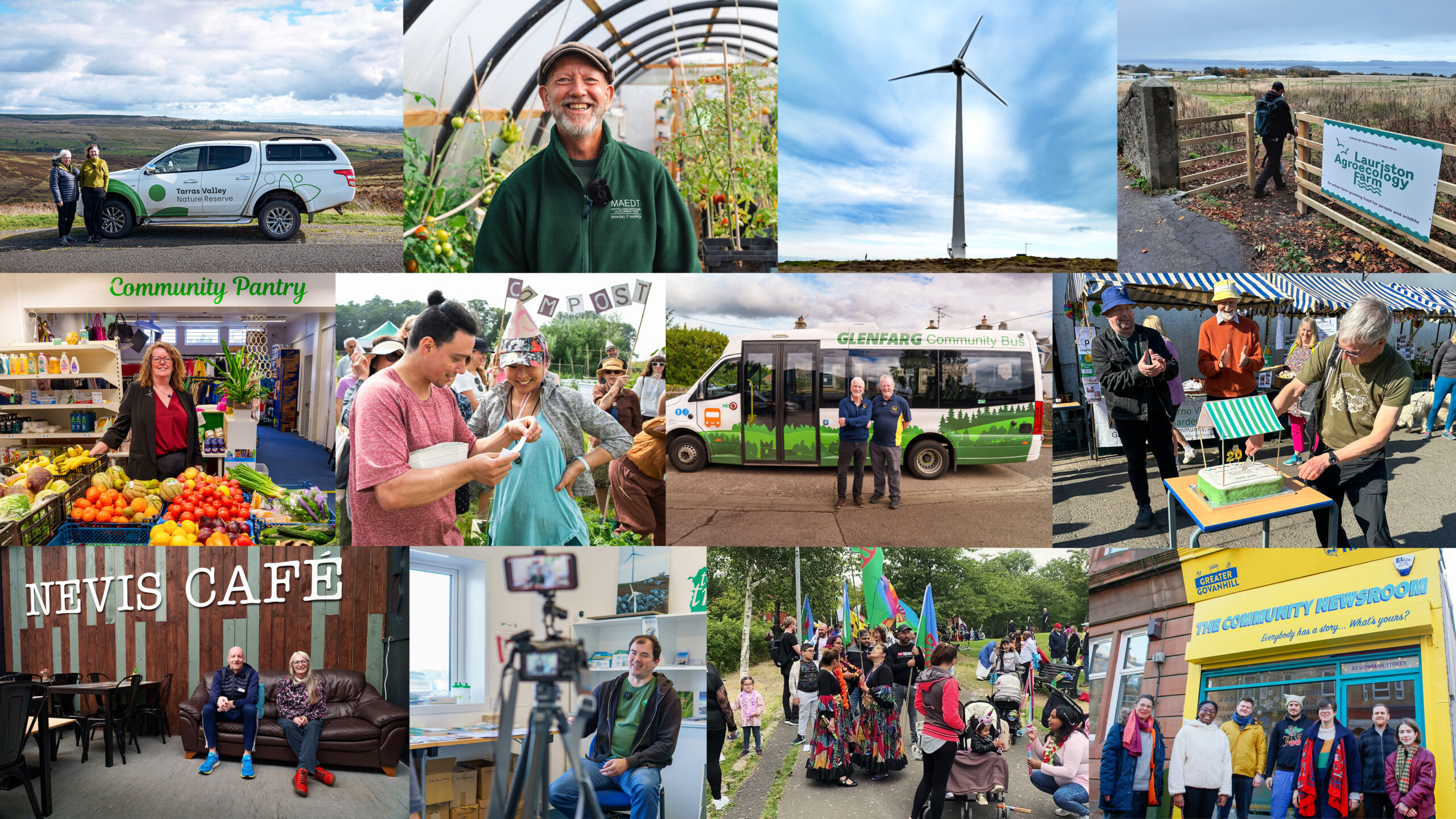
To help fill in the picture of what’s already happening on the ground, in Autumn 2025 we travelled the breadth of Scotland with storytellers from Greater Community Media, to tell the stories of how community organisations are shaping community wealth building in Scotland:
In Glenfarg, a community rebuilt its bus service after commercial operators withdrew, reconnecting residents, and becoming a catalyst for wider regeneration.
On Tiree, a community-owned turbine is powering investment into essential infrastructure, services, new homes and local businesses.
In Govanhill, a community-led newsroom is showing how owning your own story is the first step to building community wealth, and strengthens local decision-making.
In Midlothian, MAEDT is feeding the community’s soul through a community pantry, café, and a derelict bowling green transformed into a thriving community garden, building local food security, skills and resilience.
These examples are not isolated anecdotes. They are a snapshot of the sophisticated, resilient, and beautifully diverse community sector that is holding Scotland together.
These organisations are the community anchors providing their communities with a fixed point to navigate from when it is most needed. And while each organisation has a different role in their communities, they are all vitally interconnected as the community sector.
Investment, not reinvention
The government’s role is not to reinvent this movement, but to invest in it.
Organisations like these should be at the forefront of shaping the future of community wealth building, because it is already their mission- building in the gaps where there is need, with limited resources they pull together, and achieve miracles.
Our sector could provide a blueprint for the future if Scotland is serious about moving to a wellbeing economy. For this to be realised, community wealth building needs to become a consistent cross-cutting priority across government.
To truly mirror the coordinated ecosystem of national networks and intermediaries representing Scotland’s diverse community sector, its principles must be built into economic development, planning, health, food systems, transport and climate policy. Their collective strength lies in deep local knowledge, shared learning and the ability to scale practical solutions. They provide a ready-made infrastructure that could deliver sustainable community wealth equitably and effectively.
Local People Leading
In February the Scottish Community Alliance will host our Local People Leading, a national parliamentary event bringing our diverse sector together under one roof. It is a rare opportunity for the people running these community organisations to sit directly with the decision-makers shaping their future.
From deep dives into funding models that ensure natural capital assets deliver long-term benefits to the people of Scotland, to planning systems that put biodiversity and communities first, this event will lay out the priorities of what matters locally, and spotlight the collective contributions that are leading local democracy and community wealth building agendas.
A challenge for 2026
As the Bill progresses through Stage 2 and we look toward the 2026 election, the dial must shift.
Communities are tired of surviving on short-term project grants while delivering long-term essential services. It stifles their potential, and stretches their resilience. Sharon Hill from MAEDT asks: “Treat us the same way we treat our community. Trust us. Respect us and support us, but trust us to do what we do.”
Our series This is Community Wealth Buildingmakes clear what’s possible when you combine care with persistence – that with trust and investment, communities can genuinely transform their futures for the common good.
To turn this legislation into reality, we need a system that builds on and invests in the community wealth building communities across Scotland are already pioneering. We need multi-year funding, genuine partnerships, and a transfer of power.
Communities know that wealth is more than money – it is wellbeing, fairness, pride and opportunity. They have built the foundations. Now, decision makers must help them build the rest.
Read more from our series This is Community Wealth Building and what we’re calling for to support Community Wealth Building across Scotland.
Reclaiming the narrative: building community wealth with community media
January 14, 2026
In one of Glasgow’s most diverse neighbourhoods, a community-led magazine is proving that owning your own story is the first step to building community wealth.
By Lucas Batt
The door to the shop at 82 Bowman Street in Glasgow’s Southside doesn’t stay closed for long. Just off the busy thoroughfare in Govanhill sits a little bright yellow shop front, gleaming like sunshine against the grey Glasgow sky. Proudly emblazoned above the door is ‘The Community Newsroom’. It is the first of its kind in the country.
Beneath is inscribed an invitation, and statement of intent: ‘Everybody has a story, what’s yours?’
This is home to community magazine Greater Govanhill. Inside, the atmosphere is less like a corporate office and more like a bustling village square. On any given Tuesday, you might find a local historian scanning archives, a group of young Roma people learning photography, and people dropping in and heading out to tell the stories of Govanhill.
This is how news is made in Govanhill now. Not extracted by journalists parachuting in from distant newsrooms, but created by people who live here, for people who live here. The door is always open. Anyone can walk in with a story, pitch an idea, or simply be part of the conversation.
But for years, that wasn’t the story being told about Govanhill.
Reclaiming the narrative
“When I moved to Govanhill in 2018 I was immediately struck by the disconnect between the way Govanhill is often described in the media compared to the reality of actually living here” says Rhiannon Davies, founder of Greater Govanhill magazine.
“It was often described in quite negative terms, but what I found was a really vibrant, friendly community, with loads of great projects, creativity, and people making stuff happen.”
Rhiannon wanted to shift that narrative. She wanted to enable the people of Govanhill to tell their stories in their own words, to find genuine solutions to challenges the area was facing, and for neighbours to feel connected enough to create change together.
With a background in journalism, events and community development, she had the idea of setting up a community magazine. But she wanted this to be community-led. So in this neighbourhood that speaks 88 different languages, she started listening.
For a year Rhiannon went to events, cafés, local businesses, bus stops, community groups – anywhere where she could go and speak to local people, asking a simple but powerful question: What do you need to know?
Those hundreds of conversations fed into creating Greater Govanhill, a social enterprise and a community magazine rooted in what people actually wanted, rather than what she thought they needed. It is a radical new approach to local news, taking a solutions-focused and community-centred approach to storytelling as a vehicle for community development.
More than a magazine
Those conversations became the blueprint for Greater Govanhill’s approach. When it launched in 2020, people saw their ideas reflected back. “They actually listened to us,” became a common refrain.
Since launching, Greater Govanhill has published more than 20 editions of its free, high quality magazine, racking up numerous national awards. The bi-monthly magazine reaches an estimated 12,000 readers through 4,000 printed copies distributed by volunteers. There’s a website with no paywall, a radio show, award-winning podcasts, and now this physical newsroom space where they host events and hold the door open for anyone with a question or a story.
What Greater Govanhill does might look like journalism, but it functions more like social infrastructure.
“I wanted to create something that was beautiful, that made people feel proud when they saw it, that made people feel like they deserve to have something of this quality,” Rhiannon explains.
“People tell me they keep all the issues. They have them on their coffee tables, on their bookshelves. They show visitors, or send them to family back home, or to people who used to live here and moved away.”
Each bi-monthly issue is co-created with local community members, many of whom have no previous writing experience. To enable this, the organisation provides community reporter training for marginalised groups, which enables them not just to tell stories in their own words, but equips them with confidence, tools, and connections they need to make change happen.
Over 150 people contributed to the magazine in 2022 alone, contributing writing, editing, illustrations and photographs. Volunteers deliver the 4,000 copies of each edition. The majority of contributors were first-time published writers, including young Roma people, Muslim women, LGBTQ+ residents, refugees, asylum seekers, and people from 13 different countries aged between 12 and 89.
“We’re not afraid to do things that journalists don’t usually do. We recognise that the journalist isn’t the person with all the answers” says Rhiannon, “we need more voices, and more diversity in the media, so we bring them in.”
Building community wealth through storytelling
This is how community media builds community wealth. It is reclaiming the narrative of the area, making people feel proud of where they live, making people feel more connected to each other and providing solutions-focused approaches to local issues. Almost all advertisers are local businesses and non-profits. And it is building the skills and confidence of individual contributors.
A young photographer with disabilities whose work was featured gained national exposure, grew in confidence, and secured a college place. A contributor with autism told the team that helping edit the magazine gave him the confidence to pitch a successful book project to a publisher. Eight new volunteers signed up at a community garden after seeing it featured. Through Greater Govanhill’s community reporter training, a young Muslim woman found her voice and decided she wanted to be a journalist, going on to secure an apprenticeship with the BBC and is now working as a journalist.
One reader credits the magazine with saving her life after learning about support for dealing with a problem landlord. Another wrote: “The magazine gave me an insight into many of these unknowns and reminded me that issues we face are being met with love, community spirit and a whole host of amazing people.”
Through telling the stories of the community, the magazine develops empathy and understanding between the people who live there. Neighbours increasingly recognise each other on the street, no longer as strangers, but as people with rich and complex histories, and shared interests and challenges. As one reader told Rhiannon’s team during lockdown: “Reading the magazine makes me feel more connected to both my neighbours and my neighbourhood”.
The power of the network
Creating something like Greater Govanhill is not easy. Advertising revenue for local news has all but collapsed, and funding is scarce, often only for short-term projects.
Seeing that there were other independent community-based publications across Scotland with shared challenges and learnings they could share, Rhiannon set up The Scottish Beacon in 2023. It is a collaborative network of 25 independent, community-based publications stretching from Shetland to Dumfries. Through it they provide peer support, sharing ideas, learnings, and skills, but also it is a platform for the publications to collaborate.
“When one village hall closes in one community that’s a local story, but if it’s happening in 10 communities, there’s a bigger story here. The idea for The Scottish Beacon is to turn local stories into national influence” says Rhiannon.
No two outlets are the same in the Scottish Beacon. Some have small paid teams while others are entirely volunteer-run. Some operate as non-profits while others are sole traders, some publish in print while others are entirely digital. What unites all these publications is that they are owned and run locally, meaning decisions about what matters, whose voices are heard and how stories are told remain rooted in the community itself.
For members, the value is clear. Julian Calvert, editor of Scottish Beacon member The Lochside Press, said: “The Scottish Beacon project helps in showing that many of the issues we face here – ranging from energy to local democracy – are not just local, but part of a pattern across Scotland, helping us to find common cause with communities ranging from Galloway to Shetland.”
Building the support infrastructure
The success of Greater Govanhill and The Scottish Beacon proved a point: communities can run their own media and communities can be strengthened through it. But they shouldn’t have to figure it out from scratch.
Recognising the need to support these community pioneers, and the opportunity of spreading the models being developed, in 2025 Rhiannon co-founded Greater Community Media. It supports people to launch community-led media projects, help existing news organisations to become more community-centred, and enables non-media organisations to use approaches like participatory storytelling and training community reporters.
It is dedicated to supporting the development of community-centred media. This approach puts listening, care, connection, and uplifting marginalised voices at its heart. It uses media as a tool to better connect and inform people, strengthening communities and enabling them to create change together. It invests in people’s capacity to tell their own stories, and builds their confidence and skills.
There are significant barriers for people wanting to set up or sustain community media organisations, with founders often facing isolation, lack confidence and skills, encountering high financial risk, and lack support networks. But Greater Govanhill and others in the Scottish Beacon show models that can be learned from and replicated. Greater Community Media exists to lower these barriers, and provide the support founders need.
Narrative power
Community Wealth Building is often associated with physical assets like land, buildings, and energy. But information and narrative power are assets too. Who gets to define local priorities, how problems are framed, and which stories gain visibility all shape what gets decided and done in communities. But when communities have more say over what stories are told, and feel better understood and connected to the people around them, they are better positioned to organise, to collaborate, and act on the things affecting their lives.
Community-centred media is a practical example of Community Wealth Building in action. It shows how by listening to people, responding to those needs, telling stories rooted in empathy, and reporting rooted in solutions, media builds the strength of a community. There is wealth in increased community pride and understanding, and when a community reclaims its voice and its narrative, it reclaims its destiny.
Community wealth building needs a platform for community voices to shape that conversation and decision-making. Greater Govanhill, The Scottish Beacon, and Greater Community Media are building the capacity for that – one story, one neighbourhood, and one network at a time.
The door is open. The stories are waiting to be told.
Read more from our series This is Community Wealth Building and what we’re calling for to support Community Wealth Building across Scotland.