Case Studies

Toisgeal Exchange

Gaelic & Island Arts & Culture

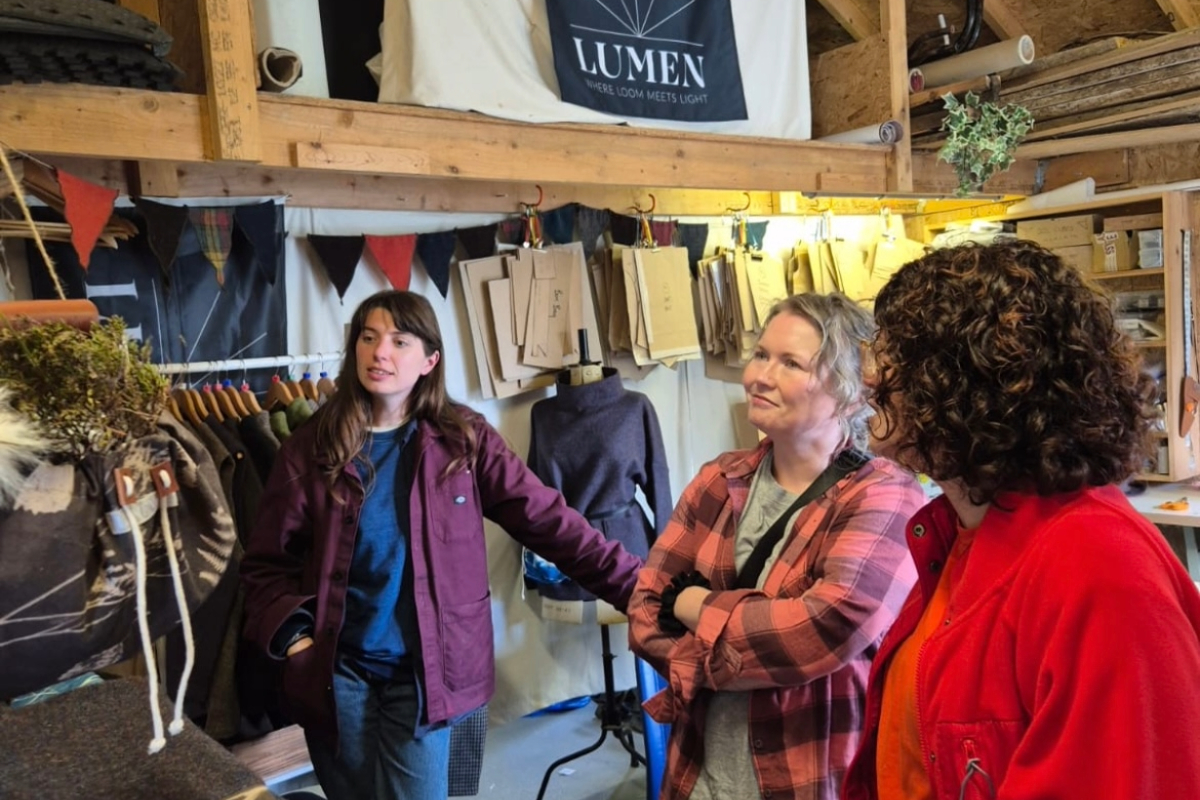
A small group of people visiting a textile studio

We discussed our hosts projects, exhibitions, practices, challenges and ways in which they collaborate with each other and with other artists, local and beyond, including the Even Here, Even Now project currently linking creative practitioners in the Outer and Northern Isles. We were able to reflect on our own aims and ethos as a group and think about ways in which we can grow our
creative community in a way that gives a voice to place-based art and practitioners, a Gaelic-focused approach to creating, and ways of mapping a path forward to future initiatives. The time we were able to dedicate to this was invaluable and in an environment that supports local creative practitioners in a very positive way.

In terms of peer-peer learning we discussed ways we could bring a joint exhibition/workshop event together and take it on the road around local village halls to engage different communities- we have started making a plan for a funding application to enable us to do so. We also identified details for a joint exhibition theme and highlighted threads to pick up for research and investigation, which we will take forward during monthly meet-ups.

Learning Outcomes

  • As our primary interest is in Gaelic/island arts and culture it would be incredibly useful to see how this has been developed and is managed in Lewis. We wish to visit and learn from groups of similarly-engaged artists who live within a similar island community facing comparable geographical and cultural challenges.
  • We have identified this visit as an opportunity to engage in peer-peer learning opportunities/skill-sharing. This will be a focused, informal environment and a supportive, effective way to encourage, strengthen and develop our creative practice.
  • We endeavour that this visit would be the start of an island-island exchange of practice and place-based learning as well as an opportunity to connect with fellow island artists and art centres/organisations on the island.

"We've learned about the variety and vitality of place-based art practices on our neighbouring island which has motivated us to seek more time to spend time collaboratively, and have been inspired to identify funding streams we may apply to to allow us to support art in different ways within our communities."

Case Studies

Biggar Community Market Garden visit to Sustainable Kirriemuir

Community food growing

Image of a yellow courgette flower

The Sustainable Kirriemuir team is managing their growing and greenspace, leading to development of ideas on how we can facilitate activities in our own local primary settings.  Emphasis was on primary school reach and how this can be leveraged to gain wider community engagement with BCMG through school newsletters and events. Sustainable Kirriemuir  focused on how volunteer recruitment and retention is successful where they invite their community to come to them with ideas which Sustainable Kirriemuir can support.  By diversifying their activities, they have embedded the organisation through a range of focuses, from health and foraging walks to large scale community events for families.  Going forward the Biggar Community Market Garden team are keen to think of how we can take similar approaches in our area so that we are responding to the needs and interests of community members to invest their time and passion into wider climate resilience goals.

Learning Outcomes

  • Gaining insights into funding and support mechanisms – community, local authority and national – utilised by each organisation.
  • Understanding the range of approaches of both organisations to volunteer recruitment and retention and extent of impact.
  • Understanding the range of approaches to engagement with nurseries, primary and secondary schools and wider community in each setting, including community engagement opportunities and the extent of impact of these approaches.

" Sharing our educational resources and experiences that can be adapted to our setting to support our learning programmes and community engagement opportunities has helped inform our approaches to nurturing good relationships with volunteers that can be implemented in our setting to support retention and recruitment. We have a better understanding of strategies for building positive and sustained relationships with local businesses, local authority and national funders which will result in financial, logistical and organisational support."

Case Studies

Greener Kirkcaldy visit to Angus Cycle Hub

Active travel exchange

Image of bikes and seating area inside Angus cycle hub

Seeing how the open workshop sits alongside the cafe and public area was invaluable. The use of easy build screens, that were very well decorated and had ample signage and information on them
greatly enhanced the experience of someone visiting for the first time. These are used very flexibly to mark boundaries between different areas, and can be moved very easily with lockable castors
The use of a screen to display a rolling slideshow about services, events and other useful information digitally was great, very professional looking and easy to amend and update to keep current at very little ongoing cost.

When classes and events take place at the Dundee Cycle Hub, everything on the floor is moveable to clear required space and the large screen is used to show films, presentations and any other useful visual aids. Most of the active travel information is there for people to access independently, but all members of staff from the workshop, retail and cafe have had in house training on how to discuss active travel and where to signpost people to find out more, especially around journey planning.

We learned about their workshop management system (Citrus Lime) and their Point of Sale system (Square) and how these don’t work together very well and discussed our won findings that Hub Tiger workshop management can integrate with Square. We were also very impressed with the simple way that Square can host online sales of bikes through their web
based shop function.

Learning Outcomes

  • Explore how active travel advice is given to individuals on site.
  • View how active travel information is displayed and accessed on site.
  • See how the cycle shop and workshop work alongside the active travel centre and cafe.

"There was a great deal of inspiration to be taken from their collaborative work with Dundee City Council, Dundee Dragons adaptive cycling and the breadth and scale of their Access to Cycles work, across the whole of Dundee and Angus."

Case Studies

Weaving Words and Wonder visit to Orkney Folklore and Storytelling Centre

Storytelling tools for inclusion

Image of a cairn in Orkney by the sea

Seeing how Orkney Folklore and Storytelling works with additional support needs has reinforced what is unique in our own practice. The storytelling is interactive with the audience and has space for children’s different ways of receiving the stories. The Centre also run ceramic workshops for children and families and we could really see the quality of what the children produce and the experience of a traditional craft – the slow process of drying the clay, firing, glazing and glaze-firing and how stories build through the characters which emerge. Also the environmental
benefits of this slow craft where there is a lot less waste than with other forms of art ‘n’ crafts.

We explored how the peoples’ Island Calendar and their partnership with the ancient landscapes and surrounding seas has shaped the social landscape of today in these magical Highland and Islands of Scotland. This will enable us to share this knowledge with our Moray audiences – to enrich our tales with the first hand account of The Islands, the islanders and their history, culture, traditions and lives.

Learning Outcomes

  • Find out about past Highlanders’ and Islanders’ culture, social customs, work traditions and beliefs.
  • Learn how to make our story telling sessions inclusive of those children who may find it challenging to just sit and listen to a story – enabling our stories to reach a broader audience and include those with Additional Support Needs.
  • To learn the Folklore, Folk Tales, Legend, Rhymes, Poetry, Sagas, sea legends, crofting tales and myths to share with our Moray audiences.

"The experience of being on Orkney brings a depth and detail to our stories which would be missing if we hadn't seen the height and majesty of the standing stones, crawled through the deep dark tunnels of the ancient chambered burial cairn of dogs and re-emerged into the bright light of morning, gentle green hills sloping down to the turquoise loch and affirming that we live because of those who have gone before."

Case Studies

Badenoch and Strathspey Community ConnXions visit to Day 1

Sustainability and making best use of local resource

People viewing a Go Kart workshop

The learning exchange was an opportunity to stop, think and reflect on our organisations future purpose and model. We are a very busy charity that has existed for 25 years and are going through an important phase of our development. It is very rare that our staff, volunteers and board get together. Day 1 are a leading social enterprise that have successfully managed to move away from sole reliance on grant funding. They deliver a range of youth work and outreach projects through income generated by the kart raceway. Their green credentials are of real interest as they generate power for their electric go-karts and deliver on their sustainability policy.

We had the opportunity to learn from the Day 1 team and apply this to the future of our organisation. We are keen to generate more income to help move away from grant funding, grow our impact in our community and improve our sustainability. There were opportunities for learning both ways and this visit also fostered stronger relationships between our organisations for the future.

Learning Outcomes

  • Social enterprise model
    Learning about the history of Day 1, the why and the idea to develop a kart raceway.
    How it works to generate income towards youth initiatives and how this impact is measured. Understanding the opportunities and challenges with running more of a commercial operation compared to working in the grant funding landscape.
  • The why – youth work
    Looking at the purpose of the organisation and the roll out of successful youth projects including employment, apprenticeships and developing key life skills for young people within the local community.
  • Sustainability
    Understanding the transition towards electric karts inc managing change. Discussing wider sustainability within the organisation inc the policy and practical measures such as Solar PV and making better use of local resources.

"On reflection, our trip was a valuable learning experience for all of those who took part. It was interesting to listen to their story and growth from a small charity into a prosperous social enterprise. It also reinforced that we are on the right path with our ethos, approach and future aspirations."

Case Studies

Door in the Wall Arts CiC visit to Edinburgh Tool Library

Sharing networks for supporting access, re-use and diversity.

3 people sitting at a table

We feel that the Community Learning Exchange with the Edinburgh Tool Library helped us better understand the processes of lending equipment and how to create a robust sharing network with our access library. It allowed us to discuss the nuances and differences in our sharing library and to create some processes around ensuring that it didn’t burden our staff and potential volunteers with time commitments.

It also allowed us to understand how to effectively deal with organisations who may be borrowing our equipment for events and to create processes around ensuring the equipment is returned on time. We established what we would need to include in a user agreement and what policies to have in place for staff and members. We also discussed how to set up a payment model for the different organisations and individuals that would be using this equipment that allows us to safeguard our services.

It gave us an opportunity to see how we could bring members and staff together to share skills and knowledge, creating a community ethos around making events accessible and learning from this work.

We learnt a lot about carbon tracking and how we can monitor and evaluate the carbon footprint our project has and how we can measure this as well as showcase the benefits of our project on reducing organisations buying these plastic products.

We had the opportunity to discuss the administrative factors around the sharing library such as insurance and the My Turn software. It gave us the opportunity to think about how our other offerings such as consultancy and training in this area might be beneficial to supporting organisations/individuals to create more accessible spaces within their events and the additional support they may require from us and how we can provide that.

We discussed how we can promote our access library to organisations across Scotland, curating information to promote the importance of creating more accessible spaces that we can display at events to raise awareness. It also helped us consider the messaging we use around our access library.

Learning Outcomes

  • Through working with the Edinburgh Tool Library, we feel that we would learn about their processes in lending equipment, creating a strong and robust sharing network with our Access Library. Learning about the policies, paperwork and administrative side of creating a sharing library.
  • This opportunity would aid us in creating hyper-local volunteering opportunities to learn skills and build a community around creating safer spaces and accessible environments.
  • We want to learn how to create learning and community opportunities around our access library sharing the benefits with the organisations and individuals that we collaborate with. The Edinburgh Tool Library is an exemplary example of an organisation that has brought members together to share skills and knowledge and create a community ethos around their sharing network and we would like to learn from their work.

"The team at the Edinburgh Tool Library were incredibly welcoming and supportive and said that we could contact them in the future if we had any further questions so we have contacts with experience within the industry should we need any further support. It was a great opportunity to make connections and see first-hand how things run in a successful and established sharing library."

Case Studies

Graduate apprentice exchange

Argyll and Bute to Edinburgh social enterprises

A group of young people smiling

Five Inspiralba graduate apprentices from different areas around Argyll and Bute headed up to Edinburgh to for a Community Learning Exchange, where we first visited Social Enterprise Scotland and then the Edinburgh Remakery. Each of us now works for a social enterprise in our area and so getting an opportunity to learn how other social enterprises and intermediaries  support each other and make an impact provided lots of transferrable knowledge.

Edinburgh Remakery provides training opportunities through work placements, volunteering chances and apprenticeships. They were able to create chances for those facing barriers to employment and help them build real life working skills and raise people’s confidence who may not be in a position yet to jump into full time employment. They run free workshops for members in their wider community. These workshops could be for repairing, upgrading or maintaining their laptops and there is also a free sewing workshop. Both of these workshops prevent people from disposing of their technology or clothing as they are learning on how to give their items a second life. They collect all technology to be recycled via an electric van and use the van to send out orders that were purchased in the surrounding areas of Leith. To send out orders they try to avoid using plastic wrapping and use cardboard filling in their boxes rather than bubble wrap.

We learned they aren’t scared to trial new things as they are aware of the changing environment and that to measure outcomes the board monitor the finances on a monthly basis, do surveys and do reports on CO2. Through this experience Inspiralba now purchase laptops for clients who are on the employability programme from the Remakery.

Learning about the different efforts ‘Social Enterprise Scotland’ (SES) put into promoting diversity and providing information for social enterprises throughout Scotland was very interesting to hear. The Rural SE Hub was awesome to hear about, since providing information in a central place online – especially to those living and working in remote areas – is an invaluable resource for everyone working in a social enterprise.

One of the consistent points throughout was that social enterprises seem to keep staff numbers relatively low. Wages are a huge cost for any organisation, the potential concept of the ‘Shared Services Model’ discussed at SES was very useful. This idea revolved around the idea of smaller enterprises employing one person who works across multiple organisations to provide for each of them – thus potentially reducing staff costs, but also potentially improving networking and promoting collaboration as well. Whilst there would be legality and confidentiality issues related to this, it is this line of thinking – trying to change how we perceive job roles and building a more sustainable business model – that makes the social enterprise model appealing for continuing to search and innovate new ways to run businesses.

Learning Outcomes

  • Understand the Social Enterprise Model:-Gain a comprehensive understanding of the social enterprise model, including its mission, vision, and unique value proposition.
    -Explore the social impact framework and how it aligns with organizational goals.
  • Promote Diversity, Equity, and Inclusion (DEI):-Understand the importance of diversity, equity, and inclusion in social enterprises and explore strategies for promoting a more inclusive organisational culture- Learn about best practices for engaging diverse communities and ensuring equitable access to resources and opportunities.
  • Evaluate Impact and Sustainability: -Develop skills in monitoring and evaluating social impact by learning how to define measurable outcomes, collect relevant data, and assess program effectiveness -Explore strategies for scaling impact and ensuring the long-term sustainability of social enterprise initiatives.

"We consider ourselves very flexible as often our income can be dependent on grants that are available on any given year. This was not the case with the Edinburgh Remakery. Their mission statement of tackling loneliness & digital poverty does not change to meet funder’s projects, which I found surprising but understandable. Social Enterprises are founded with objectives and goals in mind to improve our lives from a sustainable aspect (improving environment, economy and social). It makes sense to stick to those principles, regardless of how funding can provide extra income at the cost of changing business direction. Not all social enterprises have that luxury to ignore or reject government grants and still be sustainable, but it was nice to hear that some SE businesses can still thrive with their initial aims and objectives at heart."

Case Studies

1st Step Development Ventures

Visit to Lang Toun Cycles

Numerous styles and sizes of bikes stacked against a fence

By spending the day with the Lang Toun Cycles Team, we learnt about the history and growth of the social enterprise. This was a key outcome from the exchange. We were able to discuss pricing strategies for products and services and also the scope for introducing new products to our range. We also identified a new source to purchase bike tools and equipment from that is saving us money and so reducing our costs.  Toun Cycles shared their volunteer policies, which have been useful in developing our own systems. Toun Cycles shared their refurbishment and quality assurance checklist documents, which we have used to develop our own records. Their documents have been fine tuned through trial and error and sharing these documents has meant we have saved time and potential mistakes.

This was a new contact for us and as well s sharing buying contacts and other cycle networks with us we feel that as an organisation we would be able to reach out to Toun Cycles in the future if we needed a critical friend to discuss something with. The sharing of ideas and discussion of common solutions will enable us to develop our enterprise more efficiently because we have been able to tap into the knowledge acquired by a relevant partner organisation. As a result of the visit our team of staff and volunteers that took part were strongly motivated to put into practice the learning and come back to the shop with lots of new ideas and inspiration. The face-to-face visit has enabled a stronger partnership of support and sharing which we hope will be long term.

A really brilliant benefit was the huge uplift the visit made to our staff and volunteers. Being able to go and visit another organisation was very good for morale and for reinforcing our team spirit to build a stronger more resilient team!

Learning Outcomes

  • Detailed understanding of how the Toun retail model has developed.
  • Stronger understanding of how their learning (what has worked well and how they have overcome challenges) can support our own retail enterprise development.
  • Expanded partnership networks and valuable peer support.

"It was valuable to share their pricing structures for work to ensure that we are pricing/pitching ourselves at the right point in the market. We had quite extensive discussions around working with diverse volunteers and some of the mutual challenges we have experienced. It was comforting to share these experiences and share some of our own ways of supporting vulnerable volunteers with often high support needs."

Case Studies

SCOTO and Community Led Tourism

SCA network to network digital exchange

Dumfries town centre showing a row of shops and cafes with two women in conversation on a bench.

SCOTO is a rapidly growing network seeking to grow, develop and raise awareness of community led tourism and secure added value from tourism for Scotland’s people and places. Community Led Tourism in the 3rd sector is a about visitor facing experiences which are delivered by the local community via social or other enterprise models which are not for profit and deliver social, economic and/or environmental benefits for the community.

This learning exchange offered networks the opportunity to identify which communities they are working with who are providing visitor services, facilities and experience and how those communities can develop, manage and promote their community as a destination.

The outcome was increased partnership opportunities between SCOTO and Traditional Arts and Culture Scotland to measure impacts of events and festivals on local tourism and with Scottish Island Federation to share expertise on the impact of cruise ships in Orkney – how the community are shaping tourism around this on their terms.

Learning Outcomes

  • To deliver positive impacts for people, places and planet: measuring impact – what difference is tourism making in communities?
  • To prioritise the common and shared interests of visitors, businesses and residents – send of place and place branding for locals and the host community.
  • To deliver enduring benefits for the whole community beyond the more limited short term interests of the tourism and hospitality industry – things that matter to our communities in place planning and action planning to recalibrate tourism.

"Responsible tourism is a collaborative approach which places an onus on all tourism players to take responsibility for their actions. It seeks to protect our people, places and the planet by reducing negative impacts and ensuring as an absolute minimum they are no worse off. COMMUNITY LED TOURISM goes further. CLT seeks added value from all tourism players and activity ensuring our people and our places are better off as a consequence of tourism – and in a way that matters to that specific community."

Case Studies

Afghan Community Group Inverness

Sharing culture through food and welcoming community spaces.

A group of people standing outside a community building holding gardening tools.

This exchange was to support the sharing of culture through food and to learn about how other community group support diverse cultures in their community through welcoming spaces.

Learning Outcomes

  • The Afghan community of Inverness has been trying for the best part of a year to set up their own cultural association and take on a space which will enable them to offer support to the growing, but very new, Afghan community in Highland.
  • SHIMCA have helped countless local orgs to find their feet by offering them space to start their ideas, and advice on how to go it alone!
  • This learning exchange will help to get the Afghan community the experience and support they need to support themselves beyond the extent of the resettlement scheme run by the government which currently support them.

“The creation of the Afghan Community Group is a significant milestone in our collective efforts to promote inclusivity, empowerment, and cultural diversity. This group offers a space for Afghan individuals and families in Inverness to unite, share their experiences, and contribute to our vibrant community.”